
As an Amazon Associate, I earn from qualifying purchases. That means, when you purchase a book using an Amazon link on this site, I earn an affiliate commission. All commission earnings go back into funding my books; editing, cover design, etc.
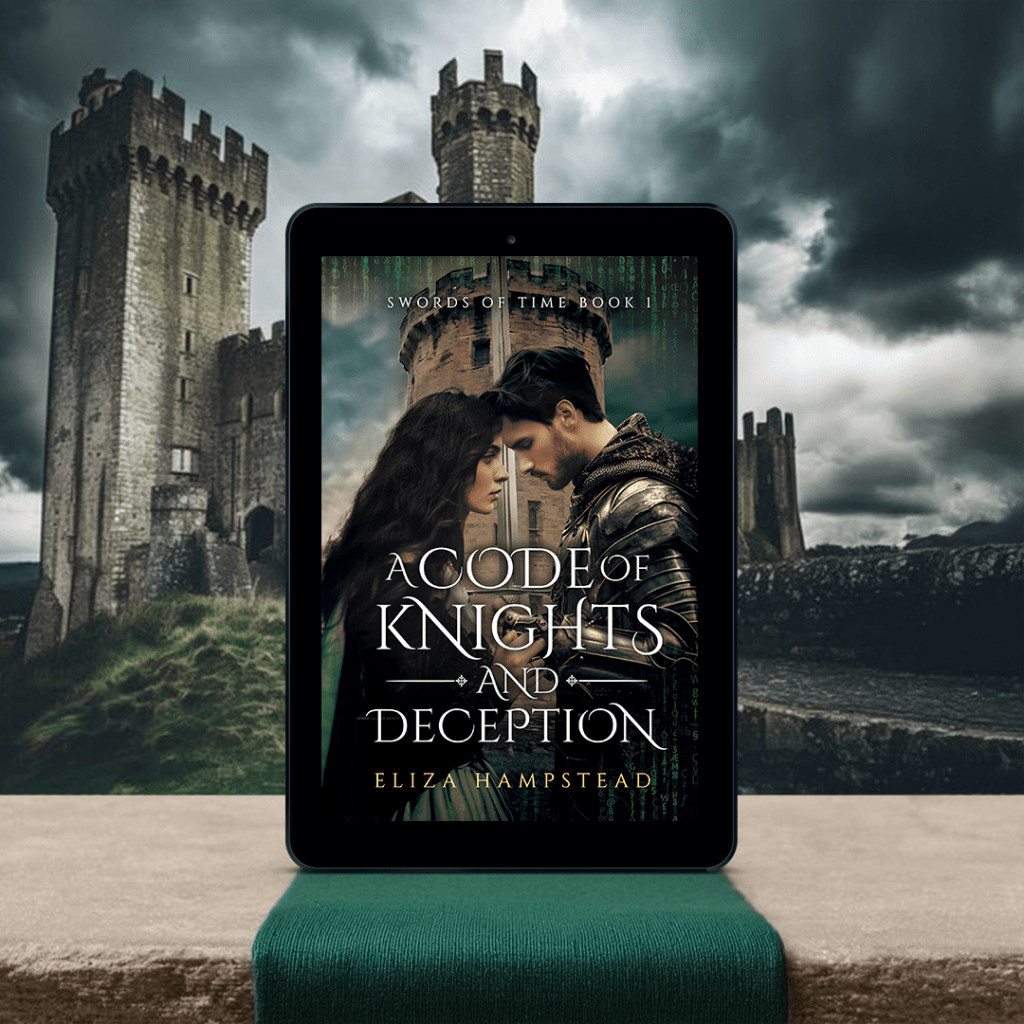

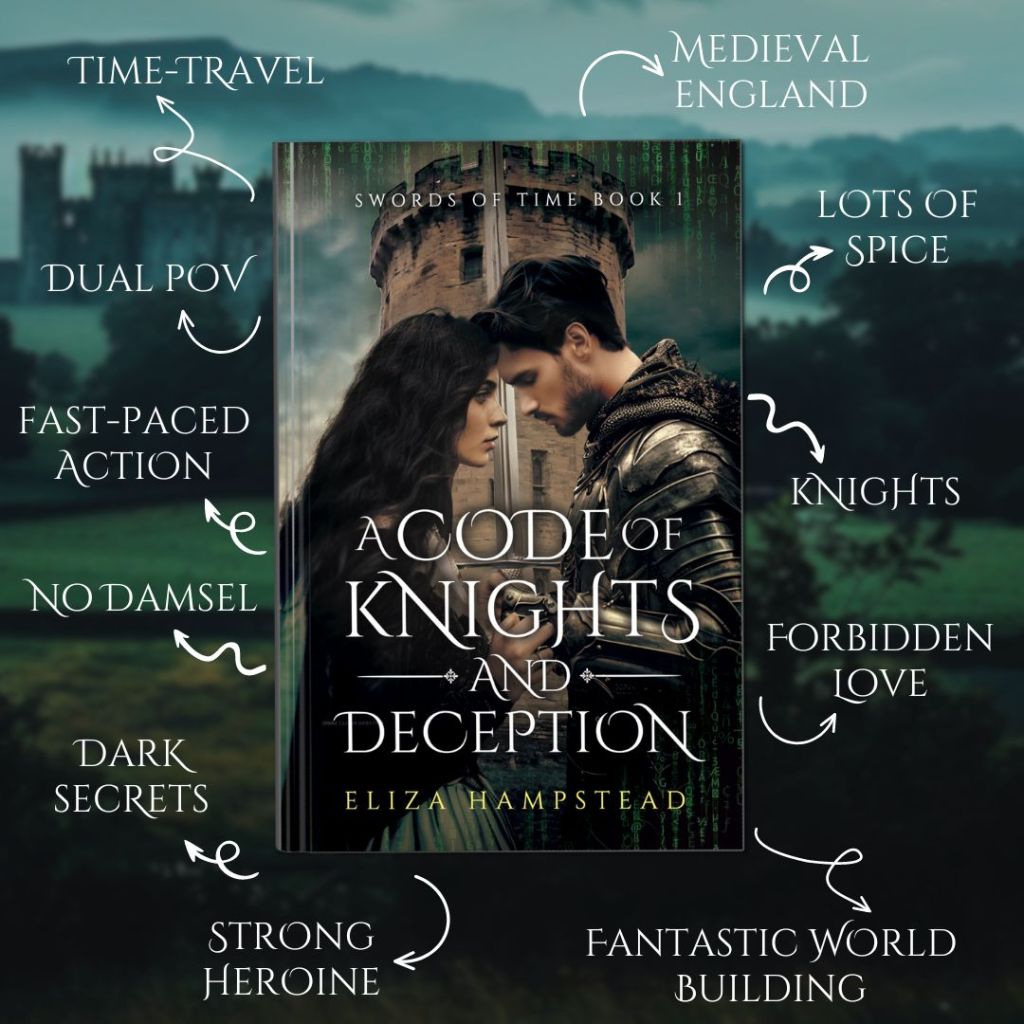
Outlander meets Black Mirror in this sizzling dark time travel romance!
A Code of Knights and Deception
Swords of Time Book 1
by Eliza Hampstead
Genre: Dark Time Travel Historical Romantasy
Outlander meets Black Mirror in this sizzling dark time travel romance!
Sophia
I thought I was trapped in history. Turns out, it’s far worse than I imagined.
I woke up in 15th-century England, a brutal world where women are silenced, superstition rules, and survival depends on obedience. Trapped far from my husband and son, nothing makes sense. I’m a scientist, not a damsel in distress, so I did what I had to—I disguised myself as a man and trained with Henry, the castle’s master-at-arms, learning to wield a sword to defend myself.
But as I carve my place in this world, my forbidden love for Henry shakes everything I believed in. Do I fight to return home—or surrender to a future I never imagined?
Yet, I can’t shake the feeling that Henry is hiding something—something that could shatter everything I’ve fought for.
Ethan
What if the woman you’re supposed to observe becomes the one you can’t live without?
I never meant to fall for her. She’s fearless, brilliant, captivating. Every lesson, every stolen moment deepens the lie—and my guilt. I’m not the man she thinks I am. That my name is Ethan, not Henry, is the least of the lies I tell her.
If she learns the truth, I’ll lose her forever.
And time is running out.
Warning: strong language, steamy scenes, and graphic violence inside. Mention/Description of, but not limited to, abduction, blood, death, amputation, childbirth, death, sexual assault, suicide, violence against children, rape, and torture.
The book is the first in a duology and ends with a cliffhanger.


Eliza Hampstead, a scientist by training, lives with her family in the UK. When she’s not writing, she spends her time as a geek. Playing all sorts of games (board games, video games, RPGs) and being a big fan of medieval history are only a few of the many hobbies she has. Passionate about fantasy, she’s always planning her next adventure.
Website * Facebook * Instagram * TikTok * Bookbub * Amazon * Goodreads

Would you like a chance to win a $10 Amazon gift card?
Follow the tour HERE for special content and a giveaway!

What kind of research do you do before you begin writing a book?
I adore research. Honestly, I probably do more than I need to—there’s something deeply
satisfying about falling down rabbit holes of obscure historical detail. For A Code of Knights
and Deception, research was both the foundation and one of the biggest time sinks. Because it’s set in 15th-century England, I needed to know everything from castle architecture to medieval bathing habits to the political climate of the time.
I started with primary and secondary sources: nonfiction books about medieval life,
particularly focusing on women’s roles, castle structure, daily life, and warfare. I studied
Warwick Castle in depth—it’s the story’s anchor setting, so I needed to understand its
geography, its history, and its evolution over time. I looked into the de Beauchamp family,
who really lived there, and imagined what it would’ve been like to walk those halls as a
stranger out of time.
But research isn’t just about accuracy—it’s about authenticity. I wanted readers to feel
Sophia’s discomfort when she’s forced into medieval gowns, to smell the smoke and sweat
of a castle’s training ground, to hear the Latin chants in a stone chapel. I even researched
medieval beauty standards, toxic cosmetics, and how women dealt with menstruation in an
era without modern hygiene. (Spoiler: it’s grim.)
I also read about VR and neurotech, because Sophia’s journey isn’t magical—it’s grounded
in science fiction. I wanted her time-travel experience to feel plausible, not fantastical, which
meant brushing up on brain-computer interfaces and speculative tech.
And then there’s the emotional research. I ask myself: How would I react if this were me?
What would terrify me? What would comfort me? I take those internal experiences and layer
them into the prose, especially during pivotal moments where Sophia’s isolation, grief, or
yearning is at its most raw.
Research grounds the story—but I’ve learned not to let it take over. At the end of the day, the
goal is emotional truth, not academic perfection. I’m writing historical fiction, not a
textbook. Still, I think readers can feel when the world is well lived-in—and that’s always
worth the extra time.

 Nina Soden