
NEW BOOK RELEASE TODAY, JULY 8, 2026
As an Amazon Associate, I earn from qualifying purchases. That means, when you purchase a book using an Amazon link on this site, I earn an affiliate commission. All commission earnings go back into funding my books; editing, cover design, etc.

Beyond the Fireworks Q&A with J. Elaine
- What inspired you to take pen to paper and write Beyond the Fireworks?
I was inspired by the quiet moments we don’t talk about enough — the ones after the noise fades. The moments when you’re lying awake replaying your life, wondering how you got here and whether you’re brave enough to change it. I wanted to explore what it feels like to love deeply, endure silently, and slowly awaken to your own truth. The story came from a desire to honor that internal shift — the moment a woman realizes she deserves more than survival.
- The novel has a poetic quality, with prose that moves readers through each scene with rhythm and flow. What drew you to this style, and how do you think it affects the reader’s experience?
That rhythm felt natural to me. Trauma and memory aren’t linear — they move in waves. Sometimes soft, sometimes sharp. I wanted the prose to mirror Celine’s inner world — reflective, emotional, layered. The poetic style allows readers to feel the story rather than just follow it. It invites them inside her thoughts instead of standing at a distance.
- You dedicated this book to your daughters. What’s one message or lesson you hope your daughters, and other young girls, take away from this story?
I hope they understand that love should never require them to abandon themselves. That strength isn’t about how much you can endure — it’s about knowing when to choose yourself. And that their voice, their safety, and their peace matter deeply.
- In what ways do you see the book creating space for conversation, reflection, or connection among survivors?
The book doesn’t sensationalize trauma. It sits with it quietly. My hope is that readers who have lived through similar experiences feel seen — not judged, not rushed, not simplified. And for those who haven’t, I hope it opens a window into the emotional complexity survivors navigate. Healing often begins when we feel understood.
- Trauma, domestic violence, and survival, and healing are central to Celine’s story. How did you navigate writing about these experiences in a way that honors the realities of survivors while serving the story?
With care. I focused more on emotional truth than graphic detail. The internal conflict, the silence, the confusion – those are often the most honest parts. I wanted to honor the reality without exploiting it. The goal was dignity, not drama.
- Were there scenes that were particularly difficult to write, and how did you approach them?
Yes, especially the abuse scenes. They were emotionally heavy. What made them difficult wasn’t just what was happening, but what wasn’t being said. I had to sit with discomfort and allow silence to carry weight. I resisted the urge to resolve the tension too quickly. That restraint was hard, but necessary.
- Fireworks serve as a recurring symbol in the novel—first reflecting Celine’s fear, and later her ability to shift from anticipating the explosion to embracing the beauty that follows. Can you speak about the significance of this symbolism and its importance to the novel as a whole?
Fireworks represent anticipation, that tense waiting for something explosive to happen. Early in the novel, they mirror Celine’s anxiety, the sense that something could go wrong at any moment. But over time, the meaning shifts. Fireworks also hold beauty, light, possibility. The title speaks to what exists beyond that spectacle – beyond fear, beyond chaos. It’s about finding clarity after the noise fades.
- The novel is shaped by Celine’s reflections on her past. How did you approach creating a layered, fully realized character whose experiences influence her decisions?
I allowed her past to live alongside her present. Celine doesn’t make decisions in isolation; she carries her childhood, her early relationships, her beliefs about love with her. I approached her with compassion. I wanted readers to understand not just what she does, but why.
- How did you develop the supporting characters, and what role did they play in shaping Celine’s journey?
The supporting characters act as mirrors and contrasts. Some reinforce what she’s used to. Others gently challenge it. They each reveal something about her – her fears, her longings, her blind spots. No one exists just to move the plot. They exist to illuminate her.
- During the writing process, did the characters ever begin to feel autonomous, or were you consciously guiding their paths throughout?
Absolutely. There were moments when I thought I knew where a scene was going, and a character’s emotional truth shifted it. That’s one of the most beautiful parts of writing — when the story begins to breathe on its own.
- As this is your debut novel, were there any parts of the writing process that felt particularly challenging, or any unexpected positive surprises you encountered?
The most challenging part was trusting my voice. It’s vulnerable to put something this intimate into the world. But the surprise was how healing the process became for me. Writing it required reflection, honesty, and growth.
- What do you hope is the main takeaway for readers of Beyond the Fireworks?
I hope readers walk away feeling less alone. Whether they’ve experienced abuse or simply felt stuck in a version of themselves that no longer fits, I hope they feel encouraged to listen to their inner voice. There is life beyond endurance. There is peace beyond chaos.
- What’s next for you as an author? Do you plan to explore similar themes in future work?
I plan to continue exploring stories centered on transformation and the emotional lives of women — particularly the moments between endings and beginnings. I’m also increasingly drawn to stories that weave intimacy with suspense, where polished surfaces conceal deeper truths. I’m excited to explore that space next.

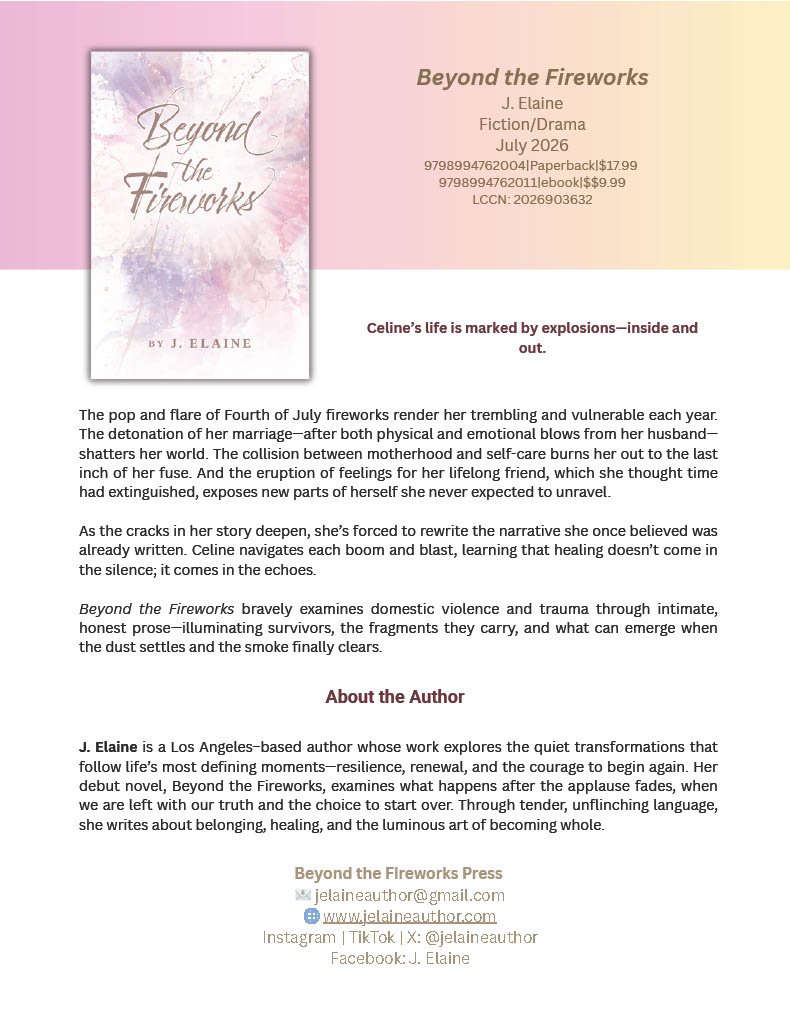
In Beyond the Fireworks, Celine begins to confront the quiet aftermath of a relationship that changed her in ways she did not yet understand. What once looked like love slowly reveals itself as something far more complicated – a web of control, silence, and emotional unraveling.
As the truth becomes harder to ignore, Celine must face the memories she has tried to soften and the parts of herself she lost along the way. Through moments of reflection, painful clarity, and the quiet courage required to move forward, she begins the difficult work of reclaiming her life.
Written with lyrical intensity and emotional honesty, Beyond the Fireworks explores the complexity of love, the lingering impact of emotional trauma, and the long, imperfect path toward healing.
This debut novel explores the moment when a woman finally sees the truth of what she endured – and begins to step beyond it.
J. Elaine is a writer and creative storyteller whose work explores healing, identity, and the quiet strength found in beginning again. Her debut novel, Beyond the Fireworks, is a lyrical work of fiction that follows one woman’s journey through trauma, love, and the difficult process of reclaiming herself.
In addition to her writing, J. Elaine is an experiential marketing strategist with a career spanning global technology companies including Microsoft and Salesforce, where she helped design large-scale programs and experiences that bring people together.
Originally from Oakland, California, she now lives in Los Angeles with her two daughters.

