Bullet Journaling for Indie Authors

1

By now, I’m sure everyone has heard of bullet journaling. If you haven’t you are seriously missing out. Bullet journaling is an easy yet fun way to stay organized and creative all at the same time. 

2

Are you interested? You should be! 

Still need more convincing? Watch these short YouTube videos to see how easy can be!

https://youtu.be/OuaaotSpifM      |      https://youtu.be/EtWmUdiMu74     |     https://youtu.be/fm15cmYU0IM

Now that you’ve watched the videos, understand how easy it can be, and are excited to start your own…

WAIT!

I want to share something with you – because I’ve made bullet journaling EVEN EASIER!

As an indie author, I wear many hats. I’m sure you do as well. So, I have created a Bullet Journal just for Indie-Authors [JUST WRITE]. 

Author Bullet Journal 8x10 Front Cover

JUST WRITE is the Ultimate Author’s Bullet Journal designed as a planner-journal hybrid to help new and experienced writers stay organized while still fostering creativity. It is the perfect complement to So You Want To Write A Book: An Indie Author Guide To Outlining And Planning Your Next Novel. Track your project progress along with daily and monthly word count goals/actuals. Plan your writing and publishing goals, maintain your personal/business to do list, never miss another deadline or appointment again, keep track of writing ideas, schedule and log social sharing and blog post ideas, keep a record of books you’re reading or want to read, maintain a running playlist, etc. There are even monthly logs to track exercise, water intake, etc.

This easy to use bullet journal is already designed to keep you motivated and organized, but there is plenty of room for creativity in the layout. Make it your own and enjoy the freedom that bullet journaling provides.

FEATURES:

  1. Dot grid Paper 
  2. 265 pages measuring at 8×10 inches each (16-inch spreads) 
  3. Sturdy matte-finish paperback cover 
  4. Perfect bound Sections in this comprehensive planner include, but are not limited to:
  • Future Log
  • Year at a Glance
  • Books to Read
  • Writing Playlist
  • Social Sharing
  • etc.

Monthly/Weekly Spreads include, but are not limited to:

  • Monthly Goals
  • Daily/Monthly Word Count Tracker
  • To-Do Lists
  • Shopping Lists
  • Notes Pages
  • Etc.

Are you interested? Good.

All you have to do to get your copy is click HERE! It is as easy as that.

Why I chose to Self-Publish instead of going the Traditional Publishing Route

self publishing

photo credit: http://www.jektz.com

Did I consider going the traditional publishing route? Of course I did. There isn’t an author, or want-to-be author, out there that hasn’t daydreamed of being picked-up by a traditional publishing house, given a huge advance, and being allowed to write full-time without fear or worry of not being able to pay the bills. 

The reality is that daydream becomes a reality for far fewer authors than you’d think. With that in mind, self-publishing has become a great alternative to traditional publishing. Over the past few years, self-publishing has also become more and more acceptable as a form of professional publishing. 

The benefits of self-publishing are numerous: 

  1. You Can Make More Money
    Unless you are Stephen King or John Grisham you have the potential to make a lot more money by self-publishing than you will going the traditional publishing route – AS LONG AS YOU DO IT RIGHT! The money you can make from your book doesn’t end with book sales, you also have to consider the possible income from movie rights, audio books, author appearances, foreign rights, and special packages that you are able to offer when you maintain full rights to your work. 
  2. Control Over Cover Design
    As a self-published author, you have final say over what your cover looks like. You will have to hire a cover artist, unless you are artistically inclined, but you control the final product. When you go down the path of traditional publishing, your publisher will take on control of your cover and often you have little to no input on how the cover looks.  
  3. Speed To Print
    As a self-published author, you control when your book publishes! That doesn’t mean you should publish your first draft, but when you are ready to publish – after all formal rounds of edits – you are in control of hitting [PUBLISH]. If you go the traditional publishing route, your publisher determines your publish date. At the time your novel is complete, your publisher may determine that the market isn’t right for the genre, this can result in your book being shelved for an undetermined time… and sometime indefinitely. Self-publishing can speed up your publication date by a year if not more.
  4. Content Control
    As an author, you put your heart, soul, sweat, and tears into your book. As a self-published author, you publish your book – the book you want to publish! As a traditionally published author, your book is changed – adapted – converted – whatever you wan to call it by the numerous interns, editors, publishers, and marketers at the publishing house. By the time your book goes to print, it may not even resemble the story you had originally set out to tell. Traditional publishers control character development, story arc, even the ending of the story, and so much more. If they say change it – you changed it. In the world of self-publishing, you determine what needs to be changed. You’re editor will give you suggestions, but you decide which of the suggestions you’re going to take and which ones you’re going to toss out with last weeks trash. 
  5. Avoiding Stress
    You are worthy! Why put yourself through the stress and anxiety of submitting your manuscript to hundreds of publishing houses only to be turned down time and time again. The fact of the matter is, it doesn’t matter how good you are – you can be turned down by a publishing house. Their acceptance is often based on the market – what is selling at the time of your submission. The following is a short list of BEST SELLING AUTHORS who were all rejected at one time or another: 
  • HERMAN MELVILLE 
  • ERNEST HEMINGWAY 
  • GEORGE ORWELL 
  • H.G. WELLS
  • F. SCOTT FITZGERALD
  • STEPHEN KING
  • WILLIAM GOLDING
  • MARGARET MITCHELL
  • WILLIAM FAULKNER
  • ANNE FRANK

NOTE: This list is just a small sample of best-selling authors who received that dreaded rejection letter… the list could go on and on and on.

8 Female Indie Authors Who Are Killin’ It

read

This article, written by Shayla Raquel, from 2015 recently popped up in my news feed, and made me realize just how far I’ve come as an author in the last 3 years.

8 Female Indie Authors Who Are Killin’ It

“It’s no surprise that girls rock. They rock so much, in fact, that we featured eight female indie authors who are killin’ it in the self-publishing world. Are you ready to meet your next favorite author?”

Awaken, Nina Soden

Genre: Fantasy/Science Fiction
Summary: Awaken is set in a world very much like our own, yet Atlanta isn’t just an ordinary city and Alee Moyer isn’t just an ordinary girl. Having barely survived her childhood, it will take the death of her father for the truth of her true bloodline to come out. Even if it means losing her life, or at least her identity, she won’t be able to escape her true destiny as the first surviving Dhampir in history. Surrounded by a new world where the horror films she grew up watching have become reality and the most unlikely characters have become her lifeline, Alee will struggle to find herself and her purpose.
When I think about an author who is always hustling toward her author goals, I think about Nina. This girl does not slow down. She is constantly working hard to push out one more book—she’s a no-excuses kind of gal and we could all learn something from her.
One reader reviewed the book, saying, “I quickly inhaled this story. The author has a very easy-to-read talent that engulfs the reader.” Ah! I pray that one day someone will read my novel and inhale it like this reader did.

What are you up to now? I am currently in the editing process for SECTOR C: The Hunted (book two in the SECTOR C Series).

Check out all 8 of the authors and read the full article HERE!

Featured Authors:

read

Building an audience can be one of the hardest parts of being an indie-author. Mainly because we do all of the marketing, publicizing, etc. on our own. So, word of mouth from readers, amazon and other online reviews, and blog posts like these are so important for our success. If you can take a minute to check out the authors on this lists, maybe you’ll find your next favorite book. If you do, comment below and tell me what you read and what you thought of it.


2018 Catfish Literary Festival

Catfish Literary Festival

4th annual Catfish Literary Festival at the Athens-Limestone County Public Library (603 South Jefferson Street, Athens, AL 35611, phone: 256-232-1233) Saturday, 4/28/18 10am to 3pm.

One of the things I love the most about being an indie-author is getting out and talking to people about my books and about the self-publishing process. I got to do just that on April 28th, when I spent the day at the Athens-Limestone County Public Library for the 4th annual Catfish Literary Festival.

The festival offers book-lovers a unique opportunity to connect with authors to chat, ask questions, purchase autographed books, and sit in on writing panels and book readings throughout the day. I was lucky enough to be asked to participate in a panel discussing the self-publishing process and to help new authors interested in self-publishing figure out if it is right for them.


If you have questions about the self-publishing process, or how to get started in the writing process, please reach out. I’d love to help. You can comment below with questions and I promise to respond. If I get enough interested in the topic, I’ll do a post answering everyone’s questions.

Do You Believe In Fairies?

Image

Fairy… Fata… Fay… Fey…Fae… Fair Folk… Etc. 

(CC0 Creative Commons – Free for commercial use – No attribution required) 

Fairy. … A fairy (also fata, fay, fey, fae, fair folk; from faery, faerie, “realm of the fays”) is a type of mythical being or legendary creature in European folklore, a form of spirit, often described as metaphysical, supernatural, or preternatural. (Wikipedia, the free encyclopedia)

If you believe in fairies, you’re not alone.

Stories of the fair folk date back to ancient times. They have been shared throughout most cultures in some form or another. Be they friendly little sprites that flutter around or be they evil flesh-eating demons, the Fae have both delighted young children and scared even the bravest of adults. 

As I do my research… (maybe for a new book ~ maybe not) I find these legendary creatures to be breathtaking and terrifying all at once. 

Tell me… do you believe in fairies and if you do what is your favorite Fae folklore? 


* * * * * * * * * *
THIS BLOG claims no credit for any images posted on this site unless otherwise noted. Images on this blog are copyright to its respectful owners. All images have been obtained legally through creative commons copyright free images, wikimedia commons, iStock, or other online sites offering copyright free images. If there is an image appearing on this blog that belongs to you and you do not wish for it to appear on this site, please e-mail me with a link to said image and it will be promptly removed.

Preparing Your Manuscript for Editing!

As a kid, I never understood why my mom would always insist that my sister and I straighten up our rooms and help clean the house BEFORE the housekeeper came.

clean

Now, as an adult, I totally get it.

The same concept applies to writers who are serious about their manuscript. You should never send the first draft of your manuscript to an editor, its like having the cleaning lady come over right after you’ve thrown a rave in your living room! I’m going to repeat that, just in case you didn’t read it correctly – YOU SHOULD NEVER SEND THE FIRST DRAFT OF YOUR MANUSCRIPT TO AN EDITOR!!!

Always clean up your house ‘your manuscript’ before sending it off to the cleaner ‘the editor’.

Now, I’m not saying that finishing your manuscript isn’t a great accomplishment – IT IS! I’m just saying that maybe that first draft isn’t fine-tuned enough to submit. So, have a glass of wine, throw a party, celebrate finishing your manuscript… then after you’ve taken a moment to pat yourself on the back, begin the next step to prepare your manuscript for submission: rewrites and author edits!

TOOLS YOU’LL NEED:

  • Microsoft Word Spell Check: OK, this one is pretty obvious and you should have been using it all along, but many people disregard spell check as an imperfect tool. The truth is, it is an imperfect tool – all of them are – but it will catch some things that even you or your beta readers might not catch.
  • Microsoft Word Grammar Check: Much like spell check, people tend to skip over the grammar check function of Microsoft Word. WHY? Sure, it isn’t always right, but if you are diligent about reading each suggestion and doing your research you are bound to fix more issues than if you skip this step completely.
  • Grammarly: OK, I LOVE Grammarly!!! It is awesome when it comes to line editing. It also goes beyond the basic spell check and grammar check to help find words that have been spelt correctly, but used incorrectly. You can use it to run reports to find things such as when you’re overusing words – MY FAVORITE FEATURE!!!
  • After the Deadline: This software using artificial intelligence to check for spelling errors, common writing errors, misused words, passive or complex phrasing, clichés, and redundant phrases. PLUS – and this is a huge bonus – it will make suggestions for words that fit better and flow more smoothly with your writing style.
  • EditMinion: A FREE electronic copy editor. You can use it to get a comprehensive overview of your writing: grammar errors, words you are using excessively, your average sentence length, passive phrases, clichés, weak words, etc.
  • Slick Write: A fast – FREE – online grammar checker. This program will edit your content for adverbs, passive voice, and even awkward phrasing.
  • Natural Reader: This FREE text to speech program allows you to listen to your manuscript. It will help you identify phrases that sound clunky, overused words, run-on sentences, words that just don’t make sense, and other mistakes you may have missed by reading the manuscript yourself.

OTHER IMPORTANT TOOLS:

  • Beta Readers – These are your family and friends who are willing to read your manuscript and give you HONEST FEEDBACK!!! Makes sure they know it is ok to hurt your feelings. Trust me, the more feedback you can get on your manuscript before you send it to a professional editor, the better. Your editor is not going to go easy on you, so prepare yourself by making your manuscript as good as you can possibly get it before submission!

Having awesome beta readers and a wonderful electronic editor that you love is a great way to start your editing process, but it doesn’t end there. Beta readers and electronic editors can NEVER replace a professional editor. These tools can – and should – help you spot basic grammar errors, redundancy, adverbs, and other technical elements, but keep in mind that they are only a first step to editing your manuscript. Think of these tools as the self-editing process that every manuscript must go through BEFORE – not instead of – sending your manuscript off to a professional editor.

There are a number of other editing softwares available… I’d love to know which ones you use and why! Comment below and share your thoughts on those I’ve listed above and others you’ve tried. 


2018 HSV Comic & Pop Culture Expo

23471968_1971024066257405_8205968782664364001_n

This past weekend was the 2018 Huntsville Comic & Pop Culture Expo, and it was SO MUCH FUN!!!

As an author, I love any event where I can interact with readers. It’s a great way to get to know what people think about the genre I write in (urban fantasy/preternatural fiction), what excites them, and what gets their reading juices flowing. This past weekend’s event was no different. In fact, it over delivered in a big way!!!

Because I had so much fun, I thought I’d share some photos of some of the amazing people I got to chat with as well as some of the expo excitement!!!

These should give you an idea of just how big this expo was. No, it’s not as big as Dragon Con out in Atlanta or Comic Con in San Diego, but for Huntsville, Alabama, this expo was huge! 

I met so many fun people, and when I say they went all out with their costumes, I mean they went ALL OUT!!! 

I even met a few national celebrities that I was over the moon to meet!!! Check them out below:

So, what did you do this weekend?

Was it even remotely as exciting as my weekend?

If you’d like more information on next years HSV Comic and Pop Culture Expo, so you don’t miss out on all the fun, check out their Facebook page by clicking HERE


How to Write a Book in 4 Easy Steps

4-steps.png

Writing a book takes time, patience, and story telling abilities. Other than that, as long as you have established an audience (say… blog followers for example), found a great team of editors, know a cover artist you trust, and are able to set up pre-publication and post publication marketing efforts (including a blog tour, YouTube vlog interview tour, Periscope appearances, live book signings, etc.), you’re ready to go. 

Don’t let me overwhelm you, this post is just about the writing… I’ll get to those other things in a different post. Lets talk about the 4 easy (insert laugh track here) steps to writing your book.

STEP 1. Decide to write a book and make a commitment to yourself to finish.

finish.jpg

This is probably the hardest part of writing a book… well, this and editing… and marketing, but this post is only talking about the actual writing processes – spilling your blood, tears, and sweat into that first draft.

‘According to writer Joseph Epstein, “81 percent of Americans feel that they have a book in them — and should write it.” That’s approximately 200 million people who aspire to authorship.’ Goldberg, Justine. T. (2011, May 26). 200 Million Americans Want to Publish Books, But Can They? https://publishingperspectives.com/2011/05/200-million-americans-want-to-publish-books/

In my experience, the problem isn’t wanting to write a book, it’s not knowing where to start and often times not believing you can. I’ve talked to so many “want-to-be authors” who have amazing story ideas, but they fail to put a single word on paper. Why? Because more often than not, the messages they are receiving from the people around them are;  ‘it will never go anywhere,’ ‘you can’t make a living as an author,’ ‘who are you kidding, you’re not a writer.’ It is comments like these that keep people, who could potentially be the next Amanda Hocking, E. L. James, or even the next J.K. Rowling, from even trying.  So, ignore the negativity, make a commitment to yourself to finish it – because you’re the only one you need to please – and move to keep going.

STEP 2. Pick a genre. Your genre will determine your page count.

book-genres

  • GENERAL:
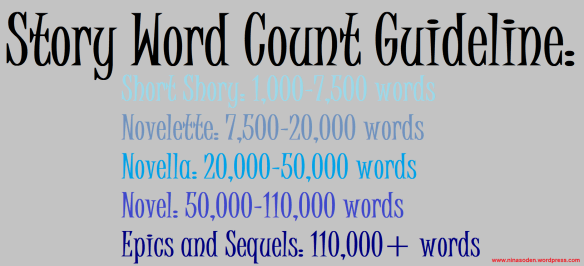
    • Flash Fiction: 300–1500 words
    • Short Story: 1500–30,000 words
    • Novellas: 30,000–50,000 words
    • Novels: 50,000–110,000 words
  • FICTION:
    • Adult Novels (Commercial and Literary): 80,000-90,000 words
    • Mainstream Romance: 80,000–90,000 words
    • Science Fiction / Fantasy: 90,000–120,000 words
    • Historical Fiction: 80,000–100,000 words
    • Thrillers / Horror / Mysteries / Crime: 70,000–90,000 words
    • Young Adult: 55,000–80,000 words
    • Epics: 120,000-200,000 words
    • Westerns: 50,000-80,000 words
  • CHILDREN’S BOOKS:
    • Picture Books: 300–600 words
      Early Readers: 200–3500 words
      Chapter Books: 4000–10,000 words
      Middle Grade: 25,000–50,000 words
  • NONFICTION:
    • Standard Nonfiction (Business, Political Science, Psychology, History, etc.): 70,000–80,000 words
    • Memoir: 80,000–100,000 words
    • Biography: 80,000–200,000 words
    • How-to / Self-Help: 40,000–50,000 words

Keep in mind that the word counts listed above are just a general guideline. There are always going to be books that break the rules and that is OK, as long as your story has the following key ingredients: 

  • A strong opening – Right from the start of your setting should set the mood and tone of the story for your readers. 
  • Balance –  You need to have a balance between SHOWING through strong, but not overwhelming, descriptions and TELLING through script-worthy dialogue
  • Diverse, well-developed characters – Keep in mind that not everyone is beautiful, people have scars (emotional and physical). Your characters should all be uniquely themselves, with their own back-stories, personalities, etc.  
  • Conflict and Resolution – Every good story needs conflict, it’s what allows the characters to develop, adapt, and change, throughout the story.
  • A satisfying conclusion – This doesn’t mean a Hollywood “happy” ending, it just means that all the plot holes have been filled in and questions have been answered… that is unless you’re leaving your readers with a cliffhanger! I have to admit, I love a good cliffhanger. 😉  

STEP 3. Outline your book with extensive detail.

outline.png

OK, you’ve made a commitment, you’ve picked your genre and have a general idea of what your word count is going to look like. What’s next? OUTLINING!!! When I tell you that you want to outline with EXTENSIVE DETAIL, I really do mean EXTENSIVE DETAIL.

Have you ever gotten lost, driving down a back road in the South? I have… You stop at the run-down gas station, hesitantly get out of your car to ask the station attendant for directions to the nearest interstate. She responds with something like, “Just turn right out of the drive. You’ll go three-quarters of a mile, just past the old Miller farm, and turn left when you see the burnt down barn. You’ll want to pass the Piggly Wiggly and the Walmart and turn right onto Orchard Lane, but if you reach the Dairy Queen you’ve gone to far. The interstate is about four miles from there and the entrance is on the left just under the overpass. You’ll see what’s left of the Jimmy loves Mary painted on the old water tower about a half mile before you get to there.” To much detail? NOT AT ALL!

Think of your outline as a sweet southern woman giving you detailed directions on how to go from the first page of chapter one to the final page of the story. 

Trust me, the outline is the hard part, but you can get through it. You see, the more detail you put into your outline the easier the actual writing process will be and the fewer bumps and bruises you’ll experience along the way. In other words, every detail added to your outline saves you from hours of writer’s block later on. So, don’t skimp – outline every thing.

Start with a skeleton outline by breaking down your story into three acts (Act 1 – Act 2 – Act 3). Within each act you need to know the background, setting, the obstacle/conflict, reactions to the conflict, and the resolution. 

After you’ve created your skeleton outline – start plotting out individual scenes in the same way, but with more details. 

Remember, this takes time. Don’t expect to finish your detailed outline in one day, but don’t give up until its done either. 

STEP 4. Write daily.

write-daily-

Remember, you’ve made a commitment to yourself to finish this book, so there can be no excuses. Writing daily is essential to developing your writing skills – your writing muscles if you will. Don’t worry if what you’re writing is crap… trust me, every author has days where all they write are pages worthy of the cylindrical file, otherwise known as the trash! 

Now lets say you’re writing a young adult story, which puts your total desired word count around 55,000 – 79,999. For this example, we will say you’re aiming for 70,000. You’re goal (I’m making this up) is to finish your book in 100 days – YES IT CAN BE DONE – that means you have to write 700 words per day. EVERY DAY!!! I don’t care if you get home from work and you’re tired. I don’t care if your mom wants to take you out to dinner for your birthday. I don’t even care if you’re sitting in bed with the flu and your achy. MAN UP and start typing. 700 words a day is not that hard – and once you start, you’ll quickly see that your daily 700 words will start to multiply as you get further and further into your story. The more you write, and follow your outline, the more the details of your story will start to unfold for you. 

So, what are you waiting for? Why are you still reading this blog instead of getting to work on your manuscript? Go… start writing, and remember this story is your creation – have fun with it.

Got tips you’d like to share with aspiring authors? Comment below to share your ideas and writing tips. 

From Destructive Chaos To Inspired Creativity… My Writing Space!

This WAS my work/writing space…

office-before-1

I was stuck in the corner, at a tiny desk, surrounded by TOTAL CHAOS! On top of being an author, I have kids, work a full-time job, own my own skincare business (Check out my website here), and am active in local theatre (directing and acting) when I have the time.

SO MY WORKSPACE SUFFERED!

My home office was somehow supposed to keep me organized in all aspects of my daily life (Full-Time Job – Director of Contracts, Mom – and all the carpools/activities that includes, Theatre, and of course WRITING). Instead, my office became a storage unit for everything and anything that didn’t have a home throughout our house. To say the office space was hard to work in would be an understatement. To say the office space was hard to write in would be like calling the grand canyon just a hole.

I decided to make a change… I set out on a mission to make my writing space more productive!

I started with the closet, which was filled from floor to ceiling with clutter! No before picture of that, sorry, but it would have scared you away!

Things got worse before they got better.

office-before-2

A LOT WORSE!

 Slowing, I started to see some improvement. It started by completely emptying out my office. Everything was touched. Every piece of paper, every container, every pencil… etc. You get the point. As I moved everything from my office to my dining room I PURGED! I threw things out, I took bags and boxes of things to Goodwill, I PURGED everything and anything I couldn’t find a need for.

The results: I STILL HAD TO MUCH STUFF!

My desk was way to small, so I decided a DIY desk – Pinterest style – was what I needed. I purchased 2 black 2 drawer file cabinets and headed to Lowes for some wood. They cut the wood there, which is perfect because I don’t own a saw. One of my friends came over to teach me the beauty of ModPodge. We attached a beautiful red and white fabric to the wood and that became my desktop. SO FAR – I LOVED IT! Yet, looking back today I can see it was more a crafting desk than a desk for creative writing.

I still had some work to do in order to create some shelving space on top of the desk… and A LOT more work to organize the rest of the room, but I was seeing progress!

This project started back in October 2016… I started writing this post in January 2017, I think. In the end… I ended up just gutting the room and boxing everything up and starting over in a new office – in a new house.

No, we didn’t move simply because I couldn’t get my office together, it was just time. The fact that I couldn’t get my office together reflected solely on my lack of time and my inability to say ‘no’. If I had said ‘no’ a little more often, I would have had more time!

Office

Here is a picture of how my office looks today… I LOVE IT! It is an open, creative, work environment and there is space for everything I need. Sure, I still need a great chair, but I do love this space.

* * * * * 

What does your work/writing space look like? Post comments and photos below and share your secrets to keeping your space creatively organized. 


It’s been to long…

OK, I’ll be the first to admit that I am NOT a very dedicated blogger. It’s true, I can’t lie and say that I am. The thing is, when I have spear time… time that isn’t already committed to work, dedicated to my family, or taken up by housework, I AM WRITING! 

The proof is in the pudding… or the publication date. lol

I’ve been writing since 2010. My first novel, Awaken, took just under 2 years start to finish. I had no idea what I was doing or how to do it, but I learned. It got easier with every book that came after.

I published one novel per year from 2012 – 2014. Three books in three years, and the Blood Angel Series was born. I was more than excited. I had a system. I had dedicated beta readers, an awesome cover design artist, and an editor that understood my writing style.

In 2015 I was able to publish the first two books in the SECTOR C Series. This story just poured out of me. I fell in love with the characters, the strange world they lived in, and I was emotionally invested in their journey.

pursuit-front-cover-1-gold

Published October 2016

In 2016, at the request of my readers, I went back to the Blood Angel Series to tell the story of Phoebe… She was an exciting, strong, independent female character who demanded my attention. For almost a year, she took me across the country and showed me the world through her eyes. 

I spent most of 2017 writing the third and final novel in the SECTOR C Series, but I’ll get to that in a minute. 2017 was also the year I decided to use my experiences to help others. After attending numerous author events, where I am inevitably asked the same questions over and over, I decided to put together 3 guides.

  1. The Invisible You – 52 Weeks of Meditations, Activities, and Writing Prompts to help you Discover YouThis is a work-book style guide/journal. I use the meditations, the coloring activities, and the writing prompts on a weekly basis to help keep me centered and focused. Since starting this process, years ago, I have been able to more quickly work through, if not avoid all together, the dreaded WRITERS BLOCK!
  2. So You Want To Write A Book – An Indie Author Guide to Outlining and Planning Your Next Novel I think this one is pretty self-explanatory… This is the book for all beginner authors, and even those that have been around the block a few times that just need a little extra help getting started or staying focused and organized when writing. 
  3. Multi-Level Network Marketing Business Tracker Not only am I a mom with a full-time job and an author… back in 2015 I started my own business as an independent consultant for the #1 skin care brand in North America. I designed this business tracker to help me, and others within the Network Marketing field, keep track of customers, sales, and business partners. No, it isn’t for everyone, but sometimes our projects are passions and other times they are practical. This project happened to be very practical and has proven extremely useful in growing my business. 

the bridge cover

Like I said, I spent most of 2017 writing the 3rd and final novel in the SECTOR C Series, The Bridge. I love where this series takes the reader, but I’ll admit this story didn’t go where I thought it would go. I usually have a clear picture in my mind, when I start a story line, of where it will end. This series was no different, but as the story unfolded I was excited to find that it continued to surprise me. Having just been released yesterday, I am eager and excited to find out what my readers think of where Zelina and the others take us in SECTOR C ~ The Bridge

WHAT IS NEXT?

Honestly, I’m not 100% sure what is next. I have a couple of story ideas I’ve been playing with, but I think I might take a little time off to do some more author events, market the books I’ve already published, and work on my blog a little more. If there are topics you’d like me to discuss, I’d love your feedback. Comment below with blog topic ideas and I’ll get to work! Until then, have a beautiful February!