Week 2 – #WritingWednesday Challenge

Today is the 2nd edition of #WritingWednesday!!!

ww

Remember, #WritingWednesday is an EASY, STRESS-FREE, weekly writing challenge.

  • Read the writing prompt below,
  • Spend 5 minutes writing (in your own voice or the voice of a character you’re writing) whatever comes to mind,
  • DON’T EDIT what you write! IT DOES NOT HAVE TO BE PERFECT!

The goal is 5 minutes of creativity.

Today I am writing in the voice of Austin Bradley Nixon, a character in my upcoming novel The Beast Within (This is not a selection from the novel).

Today’s writing prompt:

Write a diary entry, dated 10 years in the future!

It wasn’t supposed to happen like this. No one was supposed to get hurt. When I think back, to where I went wrong, it all started with that cat. That damn cat. Or maybe it was Suzi. Suzi Denson, with her perfect smile and baby powder perfume. How was I supposed to resist her? How is any man supposed to resist someone so perfect… so beautiful… so—.
There’s no reason to dwell on the past, it doesn’t help. My therapist says it only distracts me from making progress, preventing me from moving on with my life. Not that I have much of a life to move onto. My world is a 10-foot by 6-foot cell. Concrete walls and steal bars are all I look at, day in and day out. I have no family, thus no one to visit me. My only friend is John Riley, the man in the cell next to mine. I’ve never seen his face, but his voice is gentle and his laugh is guttural. I imagine him to be a portly man with rosy red cheeks and a soft smile. I don’t know why he’s in here, we don’t talk about the past. But, if he’s on death row too, it means he must have done something pretty bad. Maybe even worse than me, if that’s possible.

© 2019 Nina Soden

* * * * *

Alright, now it’s your turn. I’d love to see what today’s writing prompt inspires in you. So, if you are willing, go to the comment section below and start typing. Take 5 minutes and let’s see what you come up with!

Write a diary entry, dated 10 years in the future!

* * * * *

51gqQbGYyAL._SX398_BO1,204,203,200_

Are you working on a manuscript, but need a little help getting organized? Check out SO YOU WANT TO WRITE A BOOK ~ An Indie Author Guide to Outlining and Planning Your Next Novel
Author Bullet Journal 8x10 Front Cover

Want help meeting your writing goals? Check out JUST WRITE: The Ultimate Author’s Bullet Journal
How long should my story be?

Image

When I started my first novel I asked myself the question, ‘how long should my story be?’ The problem was, I was asking the wrong question and at the wrong time!

As a writer, don’t worry about the length of your story… at least not before you’ve even begun writing. Just write! Stare at the empty screen and start typing. Pound out your first draft and then ask the right question:

Is my story a short story, novelette, novella, novel, or epic?

Once your story is complete, then look at the word count in order to determine what “length” of a story you’ve written. The answer to this question is easy, because it is based on your final word count. Don’t let the desired word count dictate what you write, allow the story to dictate what you write. If you worry about word count, while you’re writing’ you may end up with way more words – and superfluous details – than necessary. 

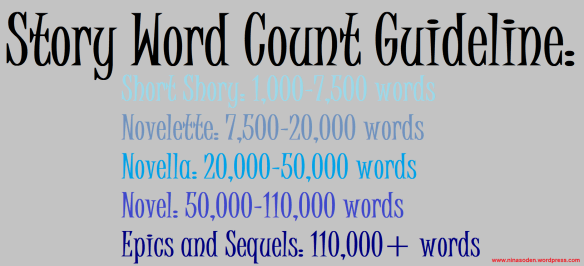
Now, I’d love to say that there are clear-cut guidelines to how long each type of story should be, but there aren’t. I’ve done a lot of research and it seems the ‘word count’ guide changes depending on who you ask. However, I’ve put together what seems to be the most common ‘suggested’ word counts:

word count

Does this mean you have to adhere to this guideline? Nope, absolutely not! They are just a guide to get you started. Write what you want to write. Tell your story the way your characters are begging you to tell it. When you’re done, call it what you want, but get that story out there for the world to see. Then, pat yourself on the back and celebrate, because you’ll have accomplished something amazing! Something you should be proud of! After you’re done, comment below and tell me what your story is and how long it ended up being, so we can celebrate together.

WWSKD – What Would Stephen King Do?

It’s no secret… Stephen King is my favorite author and I just don’t see that changing any time soon. Now, it doesn’t mean I love everything he writes, because I don’t. However, I do love most of it!

The thing is, Stephen King is the author that made me first fall in love with reading. It was his books that got me through not only my youth but also some pretty tough times in my life. Lonely times.

So, as an author myself, I often turn to my “mentor” and seek his guidance. I ask WWSKDWhat Would Stephen King Do? I’m actually thinking about getting #WWSKD bracelets made… I wonder if other authors think the same thing. Maybe I should start a club… I digress.on writing

Stephen King has written at least 90 books… probably more. Check out his online library HERE! His books have sold more than 350 million copies. AMAZING, right?! It doesn’t matter if you love them, like them or even hate them, you have to admit 90+ books is impressive. He has even written the manual on writing… literally! In his book, On Writing Stephen King shares all his thoughts on writing including his ‘rules’ which he admits, like most authors, even he breaks from time to time too.


He also shares a lot of advice for aspiring writers. I’ve picked some of my favorite quotes and shared them here:

  1. “You don’t need writing classes or seminars any more than you need this or any other book on writing. Faulkner learned his trade while working in the Oxford, Mississippi post office. Other writers have learned the basics while serving in the Navy, working in steel mills or doing time in America’s finer crossbar hotels. I learned the most valuable (and commercial) part of my life’s work while washing motel sheets and restaurant tablecloths at the New Franklin Laundry in Bangor. You learn best by reading a lot and writing a lot, and the most valuable lessons of all are the ones you teach yourself.”
  2. “While to write adverbs is human, to write ‘he said’ or ‘she said’ is divine.”
  3. “Language does not always have to wear a tie and lace-up shoes. The object of fiction isn’t grammatical correctness but to make the reader welcome and then tell a story… to make him/her forget, whenever possible, that he/she is reading a story at all.”
  4. “Timid writers like passive verbs for the same reason that timid lovers like passive partners. The passive voice is safe. The timid fellow writes “The meeting will be held at seven o’clock” because that somehow says to him, ‘Put it this way and people will believe you really know. ‘Purge this quisling thought! Don’t be a muggle! Throw back your shoulders, stick out your chin, and put that meeting in charge! Write ‘The meeting’s at seven.’ There, by God! Don’t you feel better?”
  5. “You have to read widely, constantly refining (and redefining) your own work as you do so. If you don’t have time to read, you don’t have the time (or the tools) to write.”
  6. “A radio talk-show host asked me how I wrote. My reply—’One word at a time’—seemingly left him without a reply. I think he was trying to decide whether or not I was joking. I wasn’t. In the end, it’s always that simple. Whether it’s a vignette of a single page or an epic trilogy like ‘The Lord Of The Rings,’ the work is always accomplished one word at a time.”
  7. “There should be no telephone in your writing room, certainly no TV or videogames for you to fool around with. If there’s a window, draw the curtains or pull down the shades unless it looks out at a blank wall.”
  8. “When you write a story, you’re telling yourself the story. When you rewrite, your main job is taking out all the things that are not the story. Your stuff starts out being just for you, but then it goes out.”
  9. “If you’ve never done it before, you’ll find reading your book over after a six-week layoff to be a strange, often exhilarating experience. It’s yours, you’ll recognize it as yours, even be able to remember what tune was on the stereo when you wrote certain lines, and yet it will also be like reading the work of someone else, a soul-twin, perhaps. This is the way it should be, the reason you waited. It’s always easier to kill someone else’s darlings that it is to kill your own.”
  10. “Mostly when I think of pacing, I go back to Elmore Leonard, who explained it so perfectly by saying he just left out the boring parts. This suggests cutting to speed the pace, and that’s what most of us end up having to do (kill your darlings, kill your darlings, even when it breaks your ecgocentric little scribbler’s heart, kill your darlings.)”
  11. “Writing isn’t about making money, getting famous, getting dates, getting laid, or making friends. In the end, it’s about enriching the lives of those who will read your work, and enriching your own life, as well. It’s about getting up, getting well, and getting over. Getting happy, okay? Writing is magic, as much the water of life as any other creative art. The water is free. So drink.”

5 KEY INGREDIENTS FOR A STRONG STORY

fashion woman girl women

Photo by Negative Space on Pexels.com

5 KEY INGREDIENTS FOR A STRONG STORY:

• A strong opening – Right from the start of your story the setting should set the mood and tone for your readers.

• Balance – You need to have a balance between SHOWING through strong, but not overwhelming, descriptions and TELLING through script-worthy dialogue

• Diverse, well-developed characters – Keep in mind that not everyone is beautiful, people have scars (emotional and physical). Your characters should all be uniquely themselves, with their own back-stories, personalities, etc.

• Conflict and Resolution – Every good story needs conflict, it’s what allows the characters to develop, adapt, and change, throughout the story.

• A satisfying conclusion – This doesn’t mean a Hollywood “happy” ending, it just means that all the plot holes have been filled in and questions have been answered… that is unless you’re leaving your readers with a cliffhanger! I have to admit, I love a good cliffhanger. 

What else do you feel are key ingredients for a strong story? Share your thoughts and comments below!