Mark S. Bacon began his career as a Southern California newspaper police reporter, one of his crime stories becoming key evidence in a murder case that spanned decades.
After working for two newspapers, he moved to advertising and marketing and became a copywriter for Knott’s Berry Farm, the large theme park down the freeway from Disneyland. Experience working at Knott’s formed part of the inspiration for his creation of Nostalgia City theme park.
Before turning to fiction, Bacon wrote business books including “Do-It-Yourself Direct Marketing,” printed in four languages and three editions, named best business book of the year by the Library Journal, and selected by the Book of the Month Club and two other book clubs. His freelance feature articles have appeared in the Washington Post, Cleveland Plain Dealer, San Antonio Express News, Orange County (Calif.) Register, Denver Post and many other publications. Most recently he was a correspondent for the San Francisco Chronicle.
“Dark Ride Deception” is the fourth book in the Nostalgia City mystery series that began with”Death in Nostalgia City”. The first book introduced ex-cop turned cab driver Lyle Deming and PR executive Kate Sorensen, a former college basketball star. “Death in Nostalgia City” was recommended for book clubs by the American Library Association.
Bacon is the author of flash fiction mystery books including, “Cops, Crooks and Other Stories in 100 Words – Revised Edition”.
He taught journalism as a member of the adjunct faculty at Cal Poly University – Pomona, the University of Nevada – Reno, and the University of Redlands. He earned an MA in mass media from UNLV and a BA in journalism from Fresno State.
History of the mystery: it stays the same—and changes
by Mark S. Bacon
Who published the first modern mystery story? It happened 180 years ago.
Modern mysteries got started in 1841 when Graham’s Magazine in Philadelphia published The Murders in the Rue Morgue by Edgar Allen Poe. Known for grim horror stories such as The Telltale Heart, Poe beat Arthur Conan Doyle and Agatha Christie by many decades in creating a detective series. The mystery introduces Paris detective monsieur C. Auguste Dupin who used his “analytical power” to solve a series of murders. He appears again in two other stories.
Later, in 1866, Fyodor Dostoevsky published Crime and Punishment. In it, Rodion Romanovich Raskolnikov, an impoverished student, murders a woman with an axe for her money. After he’s killed her he becomes confused and paranoid. Enter the detective, Porfiry Petrovich, head of the investigation department. Petrovfich questions Raskolnikov at length using psychological techniques to wear him down.
When I read Dostoyevsky’s masterwork several years ago I was struck by Petrovich’s interrogation style. It reminded me of the old TV show Columbo in which Peter Falk would hound a suspect with dumb questions and hypotheticals until he or she confessed. Later I read that William Link, producer and writer for Columbo, actually based his detective’s style on Dostoyevsky.
Shortly after Crime and Punishment, 1868, English writer Wilkie Collins wrote The Moonstone, considered the first classic mystery novel and one that established many of the ground rules for the modern genre. It’s a tale of murder and a stolen diamond from India.
Two years later, Collins’ better-known contemporary, Charles Dickens, started The Mystery of Edwin Drood, but died before he could finish it. Then in 1887 Conan Doyle’s Sherlock Holmes appeared for the first time in A Study in Scarlet.
Leap ahead almost a century and a half and DNA, cell phones and myriad other advanced technologies have replaced the magnifying glass for crime novel detectives. In some mystery and thriller novels today technology almost overshadows the characters. I didn’t want that to happen with Dark Ride Deception, my new mystery.
The story takes place in Nostalgia City, an Arizona theme park where a computer genius has just invented a remarkable new technology that will transform theme park rides forever. But the plans and computer programs that created the Deception Perception Effect are stolen. My protagonists are set off on a mission to solve the theft and the disappearance of the computer genius behind the new technology.
Rather than fill the story with complex tech, however, I focus on the players including my ex-cop turned Nostalgia City cab driver, Lyle Deming, who goes undercover to spy on other theme parks suspected of corporate espionage.
Technology is important to today’s mysteries, but it’s the people, the characters, who have always made tales of murder come alive.
Would you like a chance to win a $25 Amazon gift card?Follow the tour HERE for special content and a giveaway!
John Calia – A Brooklyn-born, second generation American and the eldest of three boys, writing is his third career and the one about which he is most passionate. Following graduation from the US Naval Academy and active duty in the Navy, he embarked on a career in business. He began writing his blog “Who Will Lead?” in 2010 attracting over 120,000 readers. It inspired him to write his first book, an Amazon five-star rated business fable titled “The Reluctant CEO.” Currently he makes his home in Fairport, NY, a village on the Erie Canal.
Can you, for those who don’t know you already, tell something about yourself and how you became an author?
Writing is my fourth (or maybe fifth) career. I have been a U.S. Navy officer, a banker, an entrepreneur and business consultant. I began writing a blog in 2010 at the encouragement of a good friend and found a following (over 120,000 readers). My brother encouraged me to write a book, but I resisted. Coincidentally, a development rep from a small indie publisher reached out to me right after my brother died (from Lyme Disease). “I’ve reading your blog,” he said. “If you ever decide to write a book, let me know. We’d love to publish it.” It took another year for me to complete The Reluctant CEO: Succeeding Without Losing Your Soul. I sent him a final draft. “It may take me a while to get back to you on this,” he said. Two days later he sent me a contract. The book was released the following year in May 2016.
The book was a success in the narrow audience I chose. It received 5-star ratings on Amazon. And that made me want to write another book. But I wanted a broader audience. I wrote a near-future, science-fiction novel “The Awakening of Artemis” which will be published on September 29, 2021 for two reasons: (1) science-fiction has a huge audience; and, (2) I wanted to write about the effect of artificial intelligence on society.
What is something unique/quirky about you?
Not a damn thing! Well, I graduated from the U.S. Naval Academy. That’s not quirky or unique. But it’s uncommon for sure.
Where were you born/grew up at?
I was born in Brooklyn – the old Brooklyn made up of ethnic neighborhoods. My father used his WWII veteran benefits to buy us a house in the Long Island suburbs, where I lived until I graduated high school. I’ve only been back for occasional visits since and have lived in nine U.S. states.
What do you do to unwind and relax?
Frankly, what I find most relaxing is writing. Other than that, I spend time on the water in the lakes and harbors of western New York state.
What inspired you to write this book?
The birth of my granddaughter, Emily Grace Martinez-Calia. She is the first female in my bloodline in 90 years. I wonder what life will be like for her 30 years in the future. What kind of world will she live in? How will she deal with mid-21st Century reality?
What can we expect from you in the future?
Book 2 in this series will likely be titled “False Flag.” It will bring in some of the recently revealed pseudo-facts from the U.S. government’s release of information about UFO’s and alien visits to Earth.
Do you have any “side stories” about the characters?
The main character is Diana Gutierrez-Adams. She grows up in a military family and elects to join the first class to graduate from the US Space Force Academy in 2040. She is grounded in traditional values and is raised by her father to be a strong independent woman. She cares about the cause of women in society and is encouraged by the ascension of women into leadership roles. She is goal oriented and focused but can undermine herself when she perceives injustice, particularly when it is directed at one of her friends and co-workers.
The formative experience of Diana’s adult life came during a war. From her underground bunker in Nevada she identified targets and launch stealth missiles toward their targets. During her shift at the controls, her base was struck by an enemy missile. She assumed control of the automated fire control system and destroyed the enemy.
Emerging from her bunker, she realized how lucky she was to have survived. Engulfed in smoke and still smoldering, the base was barely recognizable. She stumbled toward HQ, the operations center, tripping several times, once over a dead body, another over a disembodied leg. The ground was hot! She burned her left hand when she broke her fall. Disoriented, weak and in pain, it took a few minutes (seemed like hours) to realize that HQ was gone – completely vaporized. In its place were smoldering ashes. No human remains were evident. Commanding the operations center that directed all the launch stations was Base Commanding Officer, Brigadier General Paul Adams – her father.
How did you come up with the concept and characters for the book?
The characters mirror the characters in The Wizard of Oz.
Where did you come up with the names in the story?
Main character: Diana: the Roman Goddess of the Hunt, protector of women and children, fierce warrior and loyal to a fault. (Dorothy is her alter ego in The Wizard of Oz.)
Her sidekick and soul mate: Gabrielle, chosen from the sidekick in the TV series “Xena, Warrior Princess. (Represents Diana’s heart.)
Nick Adams: An often-used name in the books written by Hemingway. Plus my Dad was named Nick. He’s a Nobel-winning mathematician in the book. (the brain.)
Tony Russo: I just like the name. (Courage personified.)
How did you come up with the title of the book?
Artemis is the twin sister of Apollo in Greek Mythology. Diana (main character’s name) is the Roman equivalent. The “Awakening” takes place because of the heroic journey that Diana undertakes on behalf of her grandfather (Nick Adams).
Who designed your book covers?
I hired a great graphics guy in the U.K. through reedsy.com. His name is Nick Castle.
If your book was made into a film, who would you like to play the lead?
Kristen Stewart or Zoe Kravitz.
What did you edit out of this book?
I started my writing career as a blogger. My editor pushed me to delete sections that sounded like an essay and slowed the story. I’ve used those sections in my author website johncalia.com/blog.
Is there a writer which brain you would love to pick for advice? Who would that be and why?
There are so many great writers. But the greatest storyteller might be J.K. Rowling. I would love to be able to pick her brain as I write my next book.
Do you prefer to write in silence or with noise? Why?
MUSIC!!! I have to have music playing to write.
Would you like a chance to win a $15 Amazon giftcard or an ebook of The Awakening of Artemis? Follow the tour HERE for special content and a giveaway!
As an Amazon Associate, I earn from qualifying purchases. That means, when you purchase a book using an Amazon link on this site, I earn an affiliate commission. All commission earnings go back into funding my books; editing, cover design, etc.
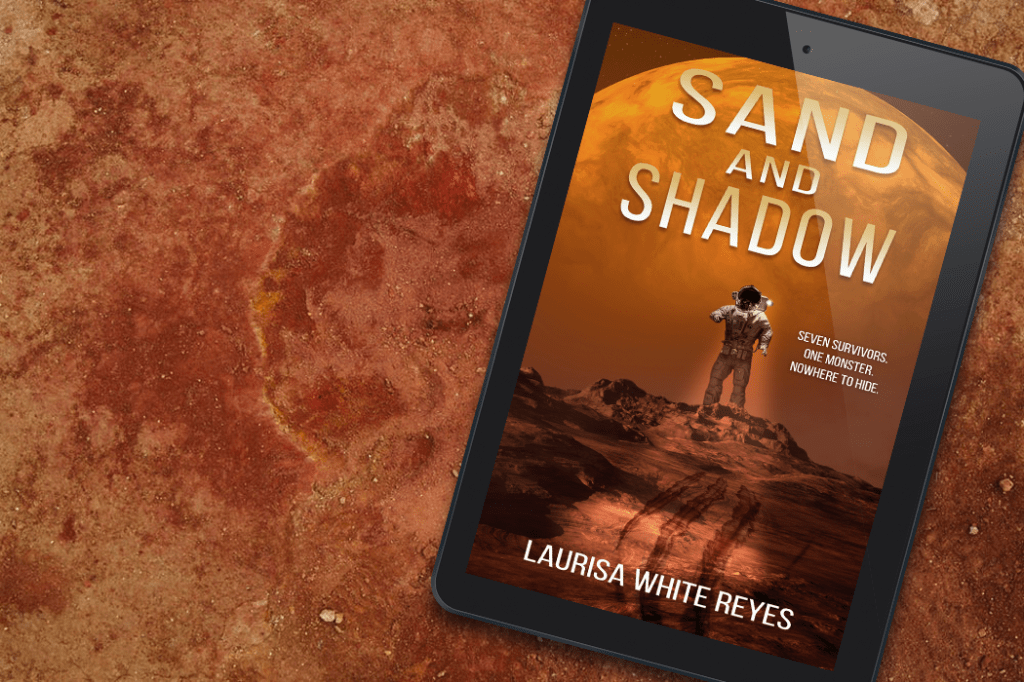
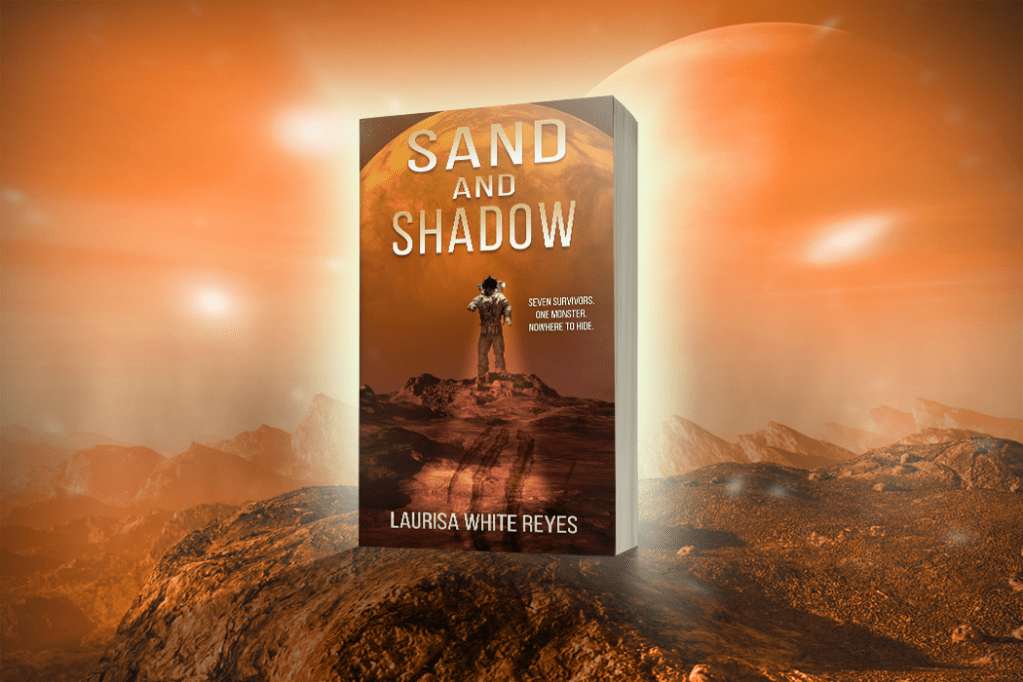
Sand and Shadow by Laurisa White Reyes ~ Genre: SciFi Horror
★Winner of the Houston Writer’s House Competition★
Seven Survivors.
One Monster.
Nowhere to hide.
Mission Specialist Adán Fuentes awakes from cryo-hibernation to discover that most of his fellow crewmates are dead and the shuttle Carpathia is not where it’s supposed to be. Surrounded by a vast barren landscape, he and the other survivors wonder how they can accomplish their mission, to establish a home for future colonists.
When an unseen creature attacks them, the Carpathia’s crew must turn their attention to surviving and solving the true purpose behind their mission.
Inspired by the 50’s sci-fi flick FORBIDDEN PLANET, SAND AND SHADOW plumbs the depths of the human psyche and the power of its influence. As the Carpathia’s crew’s secrets and flaws are revealed, readers may find themselves compelled to examine their own dark places.
Laurisa White Reyes is the author of sixteen books. Her middle grade novel THE STORYTELLERS won the 2015 Spark Award from The Society of Children’s Books Authors & Illustrators (SCBWI) and her young adult novel PETALS received the 2017 Spark Honor Award.
In addition to writing, Laurisa also is the founder and Senior Editor of Skyrocket Press, which publishes quality fiction and non-fiction for a variety of readers. She also teaches English composition at College of the Canyons in Southern California. To subscribe to Laurisa’s monthly newsletter, visit her website at www.LaurisaWhiteReyes.com
Writer’s block. It’s real, folks. Seriously. Take right this moment as an example. I wanted to sound pretentious, informative, and intellectual, permitted to sit among the greats, but really, I’m just me- a writer with the block. The block is called “The Guest Post.”
For me, I dislike calling it a block. A block feels like a Rubix cube or a blockage in the circulatory system. One aspect is easily solvable if you know the formula or have the time to take off the stickers and place them on the cube correctly. The other image? Well, without proper medical care, that shit can kill you.
Unfortunately for me, I don’t have the patience to take off the stickers on a Rubix cube, nor do I feel like getting probed to see if I’m going to kick the bucket anytime soon. Let’s face it; neither image feels very “Author.”
Nope. I consider the block as a wall because that’s what it is. You are running through a maze made by your imagination, and you made the wrong turn, meeting with a wall- The Writer’s Wall.
So, what do you do about the wall? It’s pretty simple. You have three options from where I stand, and all of them suck, but hey, you can get around it.
Option one is backtracking. Follow down the path you just went through and see what had caused you to make that wrong turn. There was one time I met the wall, and I backtracked. It turned out that a secondary love interest to the triangle wanted more screen time. It turns out he was a central character, that he had personality, and I needed to show it. I have to rewrite that story again because it turns out I still haven’t given him the love he needs.
Option two is breaking the wall. Just go for it. Write something completely off the wall in your story. Force the story to happen. Just grab that sledgehammer and slam it into the bricks, break the plaster, cut through the drywall, and make that small home into a beautiful renovation that will make HGTV cry tears of adoration. This is an excellent option if you are on a blank page. A great example of me doing that is at the beginning of this post. That was me taking the sledgehammer into the wall.
Option three is parkour. Come on. I know you had to have run and jumped on a jungle gym as a child. Do you remember being fearless? I do. Sometimes, I do silly things and twirl, all the while screaming “Parkour.” Yes, it does make people stare at me, but hey, it works. No, I don’t do actual parkour, but I do like to do something physical and productive to break what keeps me from writing. Usually, it is chores or just doing something silly. What matters is you don’t focus on the act of writing. Instead, you do something different. Eventually, the blood will get to the brain, and the brain will hit the imagination, thereby helping you write.
So, is the block actual? Yes, but it’s a wall, and everyone knows that if you can build a wall, you can tear it down. That’s why we made catapults, to fly over them and take over the kingdom.
Rachel Rossano is a happily married mother of three children. She spends her days teaching, mothering, and keeping the chaos at bay. After the little ones are in bed, she immerses herself in the fantasy worlds of her books. Tales of romance, adventure, and virtue set in a medieval fantasy world are her preference, but she also writes speculative fantasy and a bit of science fiction.
When my kids were young, naptimes and bedtime were my writing time. Now that I have pre-teens and teens, they are old enough to respect my need for writing time. I announce when I will be writing that day and then enforce only an emergency rule. It is a challenge because I love my kids and enjoy spending time with them, but I have to write if I am going to produce more books.
What inspired you to write this book?
Rumpled Rhettcame from multiple inspiration sources.
First, there was the huntsman from fairytales. He appears most notably in “Snow White” and “Red Riding Hood.” I always thought he should have a story of his own. Years ago, a friend of mine started writing a story about Snow White and the huntsman, which I really enjoyed. She never finished it, but I couldn’t shake the idea that the huntsman needed his own story.
There is the billed source of inspiration, Rumpelstiltskin himself. The fairytale was always a fascinating one for me. After reading K. M. Shea’s retelling, I began brainstorming alternative stories where Rumple could be the hero of his own tale. By the way, I highly recommend K. M. Shea’s Rumpelstiltskin.
Then, there was a surprise inspiration source in Between Floors by W. R. Gingell. Athelas and the dynamic between him and Pet inspired the crisis point at the climax of Rumpled Rhett.
Oh, and finally, I was inspired by “The Highwayman” by Alfred Noyes. The fact it has been a favorite poem of mine since childhood probably betrays a bit more of the strangeness of my interests. It is a tragedy, and I almost exclusively write happy endings (my two tragedies are short stories in The Making of a Man short story anthology, if anyone is interested).
What did you enjoy most about writing this book?
I absolutely loved Rhett. Writing his character was fun from the beginning to the end. After adorkable Silas in Grace by Contract and scholarly Crispin in Reclaiming Ryda, it was wonderful to get back to one of my favorite kinds of heroes, the man of action and danger. Who doesn’t daydream about a hero capable of defending her from the trials of life?
Do your characters seem to hijack the story, or do you feel like you have the reigns of the story?
It depends on the book, but most of my characters tend to hijack their own stories. In the case of Rumpled Rhett, Rhett had a moment where he insisted on burning Cat’s socks. The struggle between me and the character became a blog post for Lands Uncharted (https://www.landsuncharted.com/2021/02/writers-life-socks-must-go-rachel.html). Spoiler: he won the argument.
Have you written any other books that are not published?
The short answer is a resounding yes. First, there is my early work which I hope will never make it into print.
Then, there is an epic science fiction romance series for which I have written the first book, Diaspora (rough draft). I can’t publish the first book until I write the second.
Oh, and I have a contemporary Christian novel written and tentatively titled White Bear. It is inspired by “East of Sun West of the Moon” and is set in the early 2000s. That one might appear soon. I have to fix a plot hole and get it through editing.
Finally, I have a long-lost (not really) fourth and final novel in The Theodoric Saga that has so many issues that it will require an extensive rewrite to bring it up to my current standards. I might just start that one from scratch…or bury it with my early work, never to see the publishing light of day.
Do the characters all come to you at the same time or do some of them come to you as you write?
It depends. Some characters appear in a flash of inspiration with their own distinct voice and personality. Those characters are the ones I spend the book discovering as I write. Other characters are built, piece by piece, either through the plotting or the writing process. Either way, writing them and finding their voice is a journey of delightful discovery.
Do you prefer to write in silence or with noise? Why?
I would prefer silence or listening to music that is so familiar that I can tune it out. But as a mother of three, I have to be flexible. Writing with the background noises of life going on around me is a necessity.
Do you write one book at a time or do you have several going at a time?
I usually only draft one book at a time, but I can be developing other book ideas while drafting one. Oh, and I publish and promote while writing the next novel. For example, at this moment, I am writing the next Once Upon a Duchy novel, editing a short novella for a multiple author project, plotting a different project, and promoting Rumpled Rhett. I am constantly juggling multiple projects.
What is your writing process? For instance, do you do an outline first? Do you do the chapters first?
First comes inspiration. An idea, an image, or just a conversation can prompt a story idea. I immediately begin playing with it in my head to see if it is viable. Does it make sense? Does it excite me? Is it something I could make work?
Once I am confident I can make it work, I start sketching a rough high-level collection of plot points. Perhaps a few characters and interactions are added. I keep mulling as I collect ideas in a Word document, so everything is in one place.
Then, I sit down and plot out a series of points. Tensions, crises, motivations, villains, antagonists, pressures, family, settings, etc., until I get a solid framework. At this point, I know that it might change and shift as I develop it.
At the same time as this plotting/brainstorming is going on, I start collecting research and inspirational pieces.
Once I have a solid handle on the story, characters, and plot, I usually start writing. I write in chronological order. No scene hopping allowed. As I write, the story changes. Sometimes the end result looks nothing like the original plan. Other times, only some things change. Frequently the climax shifts around depending on what is needed to tie it all together into a satisfying ending.
When I finally finish the rough draft, it is time for proofing, beta readers, editors, and final polishing.
How long on average does it take you to write a book?
Oh, that is a tricky question. Some of my books, like The Talented Trilogy, took years and years. While others, like Rumpled Rhett, took about six months. It depends on what else is going on in my life, the time I can devote to getting words on the page, and my health. Writing while dealing with brain fog is dangerous. Characters do unexpected things, I drop words, or make little sense on those days.
Would you like a chance to win a $15 Amazon gift card? Follow the tour HERE for special content and a giveaway!
As an Amazon Associate, I earn from qualifying purchases. That means, when you purchase a book using an Amazon link on this site, I earn an affiliate commission. All commission earnings go back into funding my books; editing, cover design, etc.
Katherine Brown is a Texas girl with books in her blood. She has been reading as long as she can remember and has been “making books” from the time she was a child. Her first few were of a non-traditional binding – cardboard & wrapping paper stapled with handwritten pages in the middle & a ribbon closure! Her love of books runs deep and she hopes to encourage readers of all ages to explore and use their imagination by helping them fall in love with books just like she did.Katherine is married to a wonderful man, Patrick, and has a spunky, smart, amazing step-daughter Lexi. Lexi is the biggest fan of this author’s first published series, School is Scary, and is constantly asking when the next book will be finished so she can read it too. When not writing or reading, you can often find Katherine eating chocolate or enjoying time with family.
Do you try to be more original or to deliver to readers what they want?
I saw this question posed and was at odds on how to answer it. The truth is, I feel like my writing is original because it all comes to me little bits at a time during brainstorming, or driving down the road and a random bit of dialogue that goes with no story I’ve written yet pops into my head and so on, thus making it very original to me. I don’t feel like I write cookie-cutter stories. In fact, sometimes I’m afraid I don’t even follow the rules of writing very well.
As a reader myself, I love a good trope. You know, the amateur artist turned sleuth will always get her bad guy; the man and woman on opposite sides of an issue will fight and fight until they realize they actually don’t want to fight but, rather, have fallen in love, the best friend has a secret crush, etc. I never get tired of them. Give me ten Beauty and the Beast retellings and I’ll love at least eight of them. Yet, as a writer, I find it difficult to follow a tried and true trope pattern absolutely and with no alterations. I don’t know if it is because it feels like copying, or if it is the fear that my story won’t live up to those stories, but somehow I always feel like my story is slightly different or unconventional in the way I tell it. In fact, I sometimes chastise myself because when I finish writing, I’m not sure I even know how to pick the correct genre to describe my book because I didn’t hit every single best-selling trope or expectation out there. Is that a good thing? A bad thing? I couldn’t really say. I have readers who leave beautiful reviews on how much they enjoyed the stories and characters especially. I have other reviews huffing that there is far too much fluff taking up the pages.
All readers are different so I think it is fine when stories are something different, as well.
However, I still feel like I try to give readers what they want: characters they can know and be invested in, and a story that draws you into it until the last page. A memorable scene. A funny line. All the feels. You be the judge; I can’t wait to hear readers’ thoughts on The Librarian’s Treasure.
Can you tell us a little about The Librarian’s Treasure?
Of everything that I’ve written, this story has taken the longest. I whipped out a beginning in no time flat, falling in love with the idea of an orphaned librarian getting wrapped up in intrigue and adventure. And then, I stopped. For whatever reason, it just felt like nothing I wrote was good enough.
A year or so later, I picked it up and tried once more. This time, it was Drake who refused to cooperate. Was he a spy? An assassin? A love interest? A messenger? Writing him felt incomplete as I couldn’t decide what his future in the book would be. So, I stopped. Again.
And then, after another almost two years, the story resurfaced in my stack of unfinished projects and I knew I wanted to give it breath and life and wings to fly into the world, your world, readers. I still loved my idea and I was ready to sit down and do the hard work of erasing and starting over fresh. No more picking up in the middle. It was hard. I hate erasing. Or backspacing, as the case may be. But I did it. And oh! I’m so glad that I did. Raegan and Drake and the League are even better than I ever imagined them (with lots of encouragement from my editor to embrace a little more fantasy for the first time). I hope that you enjoy spending time with Raegan and Drake and getting to know them as much as I did. It was so refreshing to finish this story, that I jumped right into writing the prequel; another something I never thought I would do….write books out of order lol, but I didn’t know it needed a prequel until the story ended and Raegan had some unanswered questions.
Thank you again for spending time with me today! Happy reading.
How long have you wanted to become an author / why did you become an author / is being an author your chosen career?
Forever. No, really. I started “making books” from cardboard and paper and ribbon as a little girl. My parents were always happy to read my scribbles. As a pre-teen, I even “self-published” a newsletter from our desktop computer and printer, charging my (married) parents separately to read about school or poems that I’d written and jokes from my little sister. I love words. The possibilities of words. The evasiveness of words. The magic that is making your words say something that brings a picture to life for you or others when those words are read.
Now, don’t get me wrong – some days my words are bogged down and written in a fog of exhaustion and they come out as low-bar as you can imagine. I have so much room for improvement, as do most people in most careers if they are honest, but I thoroughly enjoy writing for the creativity of it. I became an author when I looked up from my day job one day and remembered my dreams; those dreams as a girl and teenager of seeing a book with my name on it, they came rushing back as I sat angrily at my desk annoyed at some coworker or customer for yet another ridiculous request. I knew that I wanted to at least take a shot at doing something that brought me happiness instead of ulcers. Even if it meant that I failed. I haven’t failed yet because I’m still pursuing this passion of weaving words together and seeing them hit the page to create a story that nobody has ever heard before. Now, I’m not a best-seller or financially at peace with my author career at this point, but that is okay because my theory is that you have to start at the bottom of any corporate ladder and work your way up; I’m willing to do the work.
I hope that readers who find my books find friends in the characters, find adventure in the pages, and find something beautiful or unique in the scenes. If they do, I’m a success already.
What does your writing process look like?
I typically can only write when my little girl is at naptime so it is a quick and quiet time of putting as many words together as I can. I have on occasion used a Disney playlist as background music, but honestly, even before my baby girl was born, I have always preferred to write in silence. The tapping of keys on my laptop is all of the noise that I need. It is literally the sound of success, being productive and getting the story out. It encourages me to think and type quickly. In fact, I can’t write nearly as well or fast using dictation. When typing, the words (a lot of the time, yes I get stuck, too) simply flow out of my fingertips.
I do like to have a snack and either water, tea, or lemonade nearby when I’m writing as well. Typically, the snack takes the form of mini M&Ms, dark chocolate chips, or peanut butter protein balls.
Follow the tour HERE for special content and a giveaway!
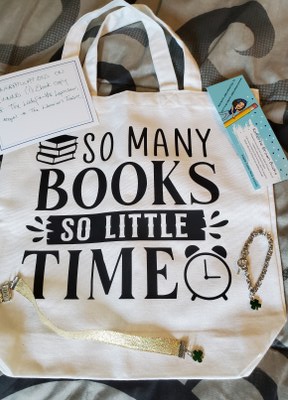
*Prize #1:*
Book tote, bookmarks, One shamrock charm bracelet, & an ebook copy of The Lady & the Leprechaun (prequel to The Librarian’s Treasure)
*Prize #2:*
Bookmarks and an ebook of The Lady and the Leprechaun
As an Amazon Associate, I earn from qualifying purchases. That means, when you purchase a book using an Amazon link on this site, I earn an affiliate commission. All commission earnings go back into funding my books; editing, cover design, etc.
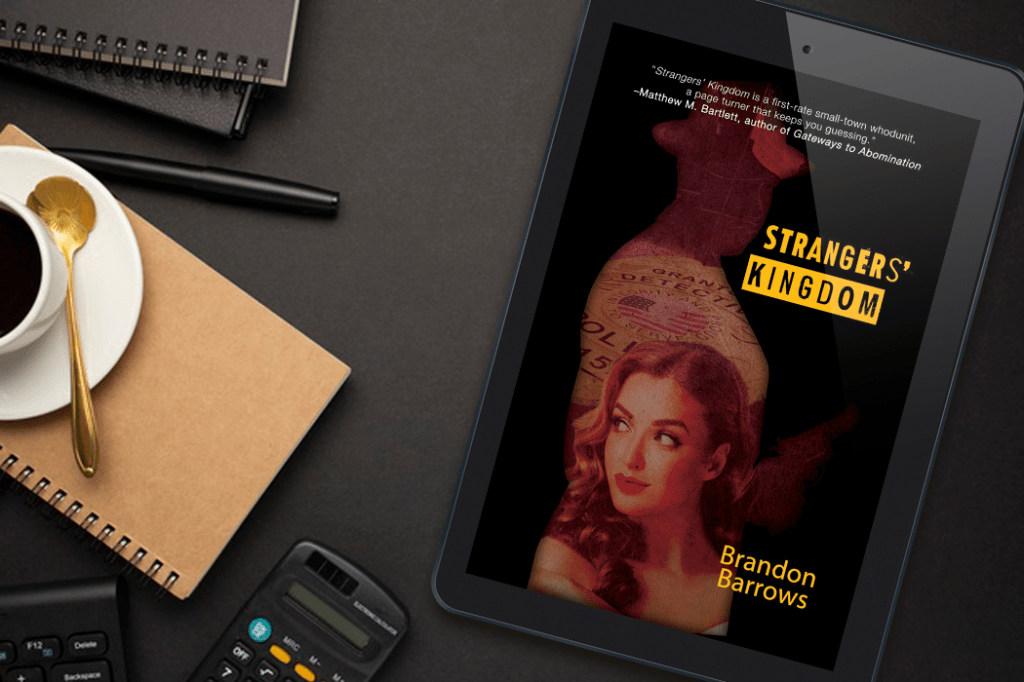
Politically blacklisted detective Luke Campbell’s last chance in law-enforcement is a job with the police department of rural Granton, Vermont. It’s a beautiful town, home to a beautiful, intriguing girl who’s caught his eye, and it’s a chance at redemption. Even if his new boss seems strange, secretive, and vaguely sinister, Campbell is willing to give this opportunity a shot. And no sooner does he make that decision than the first in a series of murders is discovered, starting a chain of events that will change the lives of everyone in this once-quiet town.
Brandon Barrows is the award-nominated authors of the novels Burn Me Out and This Rough Old World as well as over fifty published stories, selected of which have been collected into the books The Altar in the Hills and The Castle-Town Tragedy.
He is also the writer of nearly one-hundred individual comic book issues.
He is an active member of both the Private Eye Writers of America and International Thriller Writers.
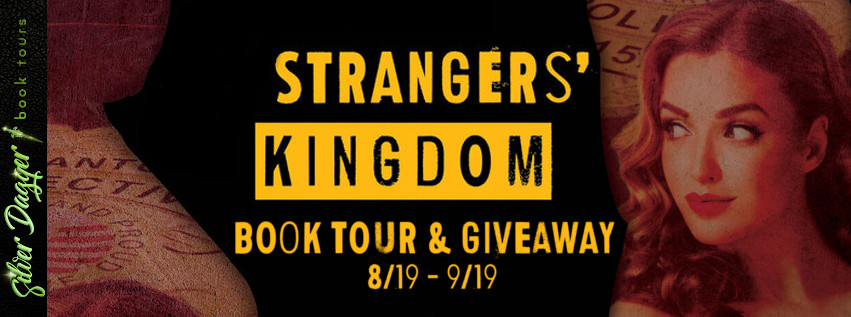
Would you like a chance to win a $20 Amazon gift card? Follow the tour HERE for special content and a giveaway!
Hi. I’m Brandon Barrows. Maybe we’ve met before. Maybe you know me from my previous novel Burn Me Out, or from stories of mine that have appeared in various magazines and anthologies. Burn Me Out and many of those stories are lodged firmly in the noir category of crime fiction, so Strangers’ Kingdom is something a little different for me: a true mystery. It’s also a police procedural set in rural Vermont, which was harder to write than it sounds.
So it’s something different for me as a writer. So what, you might think. Well, I’ll tell you: because it’s a novel I put a tremendous amount of effort, heart, and hopefully you’ll agree, soul into that I know you’ll enjoy.
Let’s start with the basics – the blurb.
Politically blacklisted detective Luke Campbell’s last chance in law-enforcement is a job with the police department of rural Granton, Vermont. It’s a beautiful town, home to a beautiful, intriguing girl who’s caught his eye, and it’s a chance at redemption. Even if his new boss seems strange, secretive, and vaguely sinister, Campbell is willing to give this opportunity a shot. And no sooner does he make that decision than the first in a series of murders is discovered, starting a chain of events that will change the lives of everyone in this once-quiet town…
How does that grab you? Interested in knowing a little more, hopefully?
Well, the setting came first. While the town of Granton is fictional, the area where the book is set, Vermont’s Northeast Kingdom, is very real. In fact, it’s where my mother grew up and a place I still have family. Being in a sort of triangle between two states and Canada, there’s a lot that goes on up there, probably more than we’ll ever know. Despite everything that can happen in such a setting, though, for most people, a rural town is a very small world and that’s certainly true of the main character, Luke Campbell. Luke grew up in Vermont, but lived most of his adult life in Albany, New York before coming to Granton. Because of that, it’s less a homecoming for him than it is a brand-new world, something both he as the protagonist and I, as the writer, were continually discovering while I wrote it.
So why a police procedural mystery? Truthfully, it didn’t start out that way. It began as a rural noir, like many of my short stories, but I discovered early on that it just wasn’t working for me. I couldn’t tell the story the way it needed to be told if I stuck to that and I liked the ideas I had for this book so much, I wasn’t willing to create something I felt inferior, so I played around with the format, switched it up, and ended up creating an entirely new protagonist to go along with the new format.
And you know, I really liked Luke Campbell, right from the start. He’s had a rough go of it, and he’s still trying to make the best of it, while going out of his way to help people—like a lonely, bullied little boy and his mother, both of him Luke comes to care about deeply—even though he’s got every right to be bitter about his situation.
Of course, he’s just one of the characters, but he is the main character and I like to think he both embodies the central theme of the novel and recognizes it for himself in the course of the work: that there are no “bad guys” or “good guys” out there, just people. Everyone does terrible things at some point in their life—whether intentionally or not—and not one of us is completely “bad”. Everyone is just trying to get along and do the best they can. Sometimes we fail at that. There are certainly criminals in this novel, but everyone in it is guilty to some extent and everyone has their good qualities, too. I always try to infuse my work with emotion, and this is something that really hit me as I was writing Strangers’ Kingdom, so I hope it’s something that comes across to you, the readers.
As I said, this is a book I put a lot of effort into. It took me nearly three years, off and on, to write – longer than any of my other novels, by far. But it was worth it. I’m very happy with it and I hope you will be, too. So do us both a favor and give it a read, will you? If you like mysteries, crime, and small-town stories about people doing their best I know you’ll love it as much as I do.
Hi. I’m Brandon Barrows. Maybe we’ve met before. Maybe you’ve read my previous novel Burn Me Out, or the one before that, This Rough Old World or possibly a story of mine in various magazines and anthologies. Maybe you’ve already ordered my next novel, Strangers’ Kingdom are eagerly awaiting the chance to dive into it. If so, my sincerest thanks.
But I’m here today to talk about something else, something all three of those novels—and honestly, most of my work, has been afflicted by at some point in the past: writer’s block.
Some people don’t believe writer’s block is real. I believe those people either have never tried writing anything or are just really, really insanely lucky to have never experienced it. All three of my published novels mentioned above have suffered from it at some point or another in the writing process.
This Rough Old World took two years and more than a dozen drafts, beginning as a twenty-five-thousand-word novella and ending up as an eighty-three-thousand-word novel before it was done. In between drafts, I often went weeks or even months without touching it simply because I had no idea what came next. The same is true of Strangers’ Kingdom, but it was even longer: three years. I got stalled at around the seventy-thousand-word mark and realized I had no idea how to end the book. It sat, completely untouched, for a year and a half before I was able to beat it into submission.
It’s frustrating. It makes you doubt yourself, your ability, the worthiness of this pursuit. You wonder, could I be doing something better with my time? But I never quit. Even when I wasn’t working on this books, I was working on something else, because I just had to. Not writing is pretty unthinkable and to be perfectly honest, the times when I can’t write hurt. It’s a kind of ache that’s almost physical, knowing you should be producing but not being able to. And eventually, you just find a way to get going again because there’s no other choice.
A lot of people say they think they have a novel in them, or they want to write a book someday, and just never get around to it. A lot use writer’s block as an excuse. That’s okay, if you’re okay with it. Absolutely no judgment.
But that’s what separates writers from regular folks: no matter how hard it is, no matter how much it hurts, you keep going, because you have to. To do anything else is unthinkable.
That’s what it was like writing Strangers’ Kingdom. I knew how the story started, but had no idea how it ended and it took me a lot of brain-wracking and soul-searching and just plain forcing myself to get it done. But I did it. And when it was done, I felt great, even though I knew there were parts I would need to rewrite. But that’s part of the process, too. The first draft is just you telling yourself the story. The guts of writing comes later, in the revising and the editing stage. It doesn’t really matter what goes into that first draft, so long as there is a first draft. That’s what I kept telling myself and that’s how I learned to break through the writer’s block.
Writer’s block still happens, of course, but learning how to deal with it is something you just have to do if you want to write. And once you do, trust me, you’ll feel great.
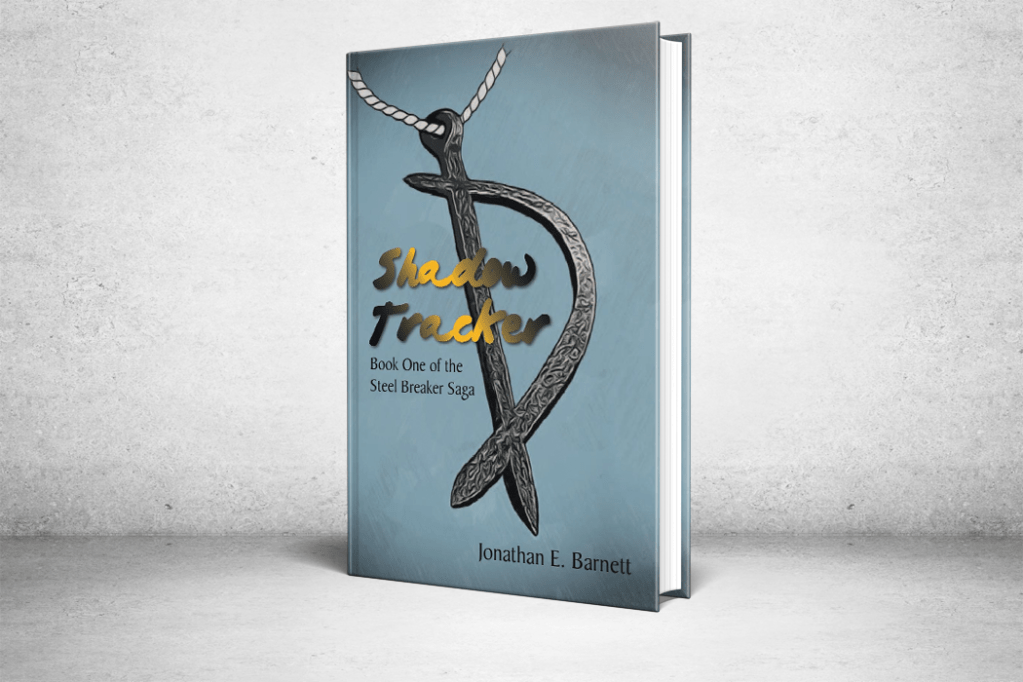
Jonathan E. Barnett grew up in Stevens Point, WI. After spending a year in a seminary in St. Paul, MN, he transferred to UW-La Crosse. He graduated with a Bachelor’s in History and a minor in Economics. Upon graduating, Jonathan was commissioned as an Officer in the Wisconsin Army National Guard and deployed twice to Southwest Asia. After his second deployment, he graduated from University of Wisconsin Law School. Jonathan is now a practicing attorney and author in Central Wisconsin.
Alcasia has been a hunter since a very young age. She hunts the most dangerous animal in the Great Forest of Rhent. The huge beasts skin hardens into a substance called brontum which is necessary in this world where iron is very rare. When taxes are raised, she ventures further than any other hunter to try and keep her family secure. This is when she accidently runs across an invading foreign army clad in steel. After escaping from this force she returns home to find these strange invaders have destroyed her village and kidnapped her brother and sister. As the village discusses rebuilding, Alcasia teams up with several friends to attempt a rescue.
Alcasia, Robyr and Trepuk lead a small band of villagers on this long mission to save their loved ones. The villagers head east toward the cities of the Plain. Alcasia will face the bigotry that people have to shadow trackers like herself as well the might of this great army of steel.
Alcasia and her band travel from the village on the edge of civilization and into the midst of a war. Alcasia moves among the armies to try and protect her loved ones. While she is known for hunting monsters, she finds herself facing a far greater monster.
An Interview with Jonathan Barnett, author of Shadow Tracker!
Can you, for those who don’t know you already, tell something about yourself and how you became an author?
I wrote a lot of poetry while I was in high school and undergrad. I never really thought of myself as an author really. As a history major, I was most interested in spending time doing some research and writing a history book, probably something centered around American immigration. I started writing fiction with this book. I was really trying to encourage my teenage daughter to work on creating a work herself. She is a very gifted writer and I told her I would write something if she did. I got hooked once I started. I would often spend days of my commutes to work just brainstorming ideas for new conflicts for my characters. I kept getting home and writing because I felt I was leaving my characters stuck where I left them.
What is something unique/quirky about you?
I had the unusual circumstance of having gone from a seminary to the Army in a matter of months. I was studying in a seminary and I knew it was not right for me. I joined the Army to pay for school, but it was odd to go from daily morning prayer to bayonet training.
Tell us something really interesting that’s happened to you!
Well, most of my very interesting stories are military related, but I do also have the honor of having tried a case that made national news. It got called the Beer Battered Fish Defense Case. It was not a big case, but the story was this guy claimed he got drunk eating beer battered fish. That was a better story than the reality. He had told the officer that the smell of beer might have been from the fish he ate. If fact, the story got too famous and the defense attorney and I agreed that neither of us would mention it in the trial. Headline the next day was “Jury doesn’t buy beer battered fish defense.” They didn’t, since they never heard that story.
Among my military stories, I was once an officer in a Security Force in Kuwait. I was required to run drills on my guard force to see how they would react. We also had to tell the Kuwaiti military when I was going out to do this. The problem was there were two Kuwaiti Colonels who were in charge of different sections of the Kuwaiti guard force and these two guys hated each other. I went out one time to take photos of the base (big no no). I phoned ahead to the Kuwaiti staff officer to warn them. While out there in my U.S. Army uniform, Kevlar helmet, ballistic vest and carrying a weapon I was approached by a Kuwaiti soldier saying something and pointing his M16 at me. Just stood there pointing at the rank on my chest knowing it was ridiculous to have this guy approach someone who was clearly an American officer like this. I showed him I was erasing the photos and later found out that the one part of the Kuwaiti guard force had been prevented from providing the warning to the other half. Lucky me.
While in the seminary I was once awoken by a drunken student coming back after bar time. This is not an unusual thing for a freshman year of college, but it was the only time it happened in the seminary. There had been an ongoing discussion about how too many seminarians were not making it down for Morning Prayer every day. Two of the seniors on my floor had been drinking and came back yelling “Wake up everyone! Time for Morning Prayer!” I looked at the clock on my desk, realized he was wrong and just rolled over to go back to sleep. The next day the guy who was yelling came around to every single room and apologized to each person on the floor. It was strange and amazing.
What are some of your pet peeves?
Most of my pet peeves are grammar and syntax related. I hate when people say “between” when they mean “among.” Also, people who say they are “anxious” for something when they mean “eager.” There are plenty more, but I try to keep that to myself. I will sometimes have a visible twitch though.
Where were you born/grew up at?
I was actually born in Sheboygan, WI and I lived in the Upper Peninsula of Michigan from about the age of four until eight. Just before my ninth birthday my family moved to Stevens Point. I really love Stevens Point. It was where we really put ourselves down and stayed. The community was always very welcoming to me. I left after high school and came back when I finally had the chance. It is a beautiful small city with a university, fantastic parks and a few great corporate citizens who provide some wonderful attractions. It is right along the Wisconsin River and there is a 20+ mile bike trail that connects most of the major parks in the city. It is big enough to have anything you need and small enough that I can be in a kayak and alone in just a few minutes.
If you knew you’d die tomorrow, how would you spend your last day?
Cliché, I know, but I would want to be with my family. I have five wonderful children and an amazing wife who keeps me in line. I would also want to spend the day with my parents, my brothers and my in-laws. My one brother lives down in Peoria, Illinois now and it is always sad to me that he is so far away. He is doing well there and happy. Of course, that makes me happy, but I wish he and his wife were closer because I miss them dearly.
Who is your hero and why?
Probably Joshua Lawrence Chamberlain. He was a general in the Civil War, but also an academic and scholar. He taught himself Greek when Bowdoin College needed a Greek professor. The guy was brilliant and went on to serve his country and his state in many ways. I admire the drive and the dedication to service that he had.
What kind of world ruler would you be?
Yikes. Well, I was an Army officer so I have some idea. I would be a coalition builder. I like to be surrounded by people who challenge me and force me to have a reason for what I believe and think. I would likely seek out great minds and try to find better systems. I like to have solid plans in place and get real leaders into positions where they can do real good for others. In all honesty, I would hate being a ruler. I would much rather be an advisor than a ruler.
What are you passionate about these days?
There is always the passion for the Green Bay Packers. Unlike most fans, the link is very much a family one. My great-grandfather was a lawyer for the Packers and a member of a group called The Hungry Five that helped keep the team afloat during the Great Depression. He is rumored to be the man who fired Curly Lambeau. He is in the Packers Hall of Fame. I see that team as a legacy and a family emblem. I love football and I love that team.
What do you do to unwind and relax?
I play a few video games that I enjoy, but mostly I read or listen to music. I love to sing and if I have time alone I am definitely blasting the show tunes around the house and belting out the hits.
How to find time to write as a parent?
I do almost all my writing after I have the kids in bed. That means I cannot start until after 9:00. I try to set one night a week where I will stay up a bit later than I should. Sometimes work can be a bit all consuming and then I try to focus on getting the sleep I need, but I like to take just one night and push the envelope a little.
I have years of military service and it definitely trained me to stay awake and still be effective. Once I spent three days awake running continuous hauling operations. My platoon sergeant and I kept telling each other that the other one should sleep. It took us several days before we both admitted we needed the sleep. We rigged up a cot in the back of a HUM-V and slept as much as we could. Having to write at night and then still get up and get the kids where they need to go and get to work is something for which life has prepared me.
I do like writing while having distraction and noise so sometimes I like to write while enjoying a movie with the family. I can sit with the laptop and enjoy the time talking with my wife and kids while I write.
Describe yourself in 5 words or less!
Husband, Father, Son, Soldier, Lawyer.
When did you first consider yourself a writer?
Probably in high school when I mostly wrote poetry. I would not have considered myself an author, but I wrote quite a lot.
Do you have a favorite movie?
I have lots of favorite movies. It really depends on my mood. My father is a librarian and he would always bring home movies from the library. We watched a lot together and still do. I enjoy movies. I probably like historical dramas the most but I do like documentaries as well. A good period piece makes me very happy since I can pick apart the things that are accurate or not. I like to follow along with the Historians At The Movies (#HATM) group on Twitter as well.
Which of your novels can you imagine made into a movie?
I only have the one out now, but I am working on book two of the series as well as on an unrelated alternate history work. I could see either being a movie, but I think the alternate history piece I am working on would likely have the better chance.
What literary pilgrimages have you gone on?
I did go to Stratford Upon Avon to visit the grave of William Shakespeare. That was pretty amazing. I was on a choir tour and I was one of only two people on the tour who walked directly across town to find the church where he is buried. Most other people just took the chance to shop. I also had the chance to see the grave of Venerable Bede while in Northern England. Interesting to see the spot where he lived and worked and then was buried.
As a writer, what would you choose as your mascot/avatar/spirit animal?
My spirit animal is definitely the Red Tailed Hawk. They live all over Wisconsin. I have found that in times of difficulty or times when I have most needed to know the mind of God I have shortly thereafter seen a red tailed hawk fly. They are powerful hunters and beautiful creatures. I feel more connection to them than any other animal (besides dogs, of course).
What are your top 10 favorite books/authors?
Dune by Frank Herbert, Band of Brothers by Stephen Ambrose, To America by Stephen Ambrose, Lies My Teacher Told Me by James Loewen, Les Miserables by Victor Hugo, Shadow and Bone by Leigh Bardugo, Gone For Soldiers by Jeff Shaara, Team of Rivals by Doris Kearns Goodwin, Hunchback of Notre Dame by Victor Hugo, John Adams by David McCullough.
What book do you think everyone should read?
Lies My Teacher Told Me.
How long have you been writing?
Since high school.
Do the characters all come to you at the same time or do some of them come to you as you write?
They present themselves as the situations arise for them to be needed. Couldn’t add some of them from the time where Alcasia is alone on the hunt. Many had to wait for the main thrust of the storyline to kick off before they came forward.
Do you see writing as a career?
That would be fantastic. I love practicing law, so I would not likely give that up. Still, I would love for my writing to be a way I can provide something more to my family and make it more valuable.
Do you read yourself and if so what is your favorite genre?
I love fantasy works, but I still mostly read history books.
Do you prefer to write in silence or with noise? Why?
I can barely think when it is quiet. I need some noise going on or my mind just starts to wander. Not sure if it’s an ADD type thing, but if there is only one thing to focus on I start to day dream. If I have music and writing then I can focus.
Do you write one book at a time or do you have several going at a time?
While writing Shadow Tracker I was only working on this book. I am currently working on two though. I am focusing on getting the second book of the series out, but I am taking some time away from Rhentsia to work on another project too.
Pen or type writer or computer?
I do outlines with pen, but I write the actual work on a computer.
Advice they would give new authors?
Just start it. Write something. You can decide you hate it later or you can add to it. You can read it after you think you are done and find ten things to add. Nothing starts until you start putting down words. Just start writing and then refine as you go. Also, have patience. Nothing worth doing is ever easy.
Describe your writing style.
I mostly do my brain storming in the car on my commute to work. I come home and start editing that in. I usually edit during the writing. I actually went through and changed large sections in the story prior to finishing my first draft. I also keep a running encyclopedia of all the animals I have created and all the people I have named at any point in the story.
What makes a good story?
Characters who change and grow and villains with an understandable purposes and goals.
What are they currently reading?
The Premonition by Michael Lewis.
What is your writing process? For instance do you do an outline first? Do you do the chapters first?
I tend to outline first and then start writing. I know I will tend to rewrite everything once or twice.
What is your writing Kryptonite?
Writing conversations is probably the hardest part for me. Writing poetry as a starting point allowed me to work on being descriptive and flow into design. Writing conversations has to maintain personality traits and I have to bounce between multiple people and their arguments or desires one after another.
Do you try more to be original or to deliver to readers what they want?
At this point I am trying to be more original. My first audience is my daughters. I want them to have a character they can follow and enjoy.
If you could tell your younger writing self anything, what would it be?
Try multiple genres and sample more things earlier. Write more short stories.
What’s the most difficult thing about writing characters from other genders?
Having characters of other genders and other ethnicities is difficult because as a white man I know I have no idea. I have to admit that and deal with that. I cannot avoid it because that would be far more disingenuous. I need to have those voices in my stories to challenge me. Thankfully, I have been surrounded by strong women in my life. My mother, my grandmothers, my wife and my daughters. In many ways, I write the women in this novel to have many of the same desires as anyone else. They want to protect their families and have jobs that give them a feeling of joy or accomplishment.
How long on average does it take you to write a book?
It took a little over a year to get the first one through the process. Some of that was bouncing revisions past others to get a sense of how it was going.
Do you believe in writer’s block?
Oh yes. Sometimes you have to walk away and maybe write something else for a bit to get in a different state of mind. I also like to talk through it with someone else or talk out loud to myself in the car to get through it.
Ashlea Thompson is an avid reader and a lover of Atlanta Braves Baseball and Crimson Tide Football. She is also a member of the Alabama Writer’s Cooperative. “Steel Hearts” is her debut novella.
Check out our interview on YouTube:
Check out HER book below!
(Click on the cover image to order your copy)
(As an Amazon Associate, I earn from qualifying purchases. That means, when you purchase a book using an Amazon link on this site, I earn an affiliate commission. All commission earnings go back into funding my books; editing, cover design, etc.)
Lottie Mae Haywood is living her best life doing what she loves. Art. When she meets Jake Samford, she believes she has found the one to spend the rest of her life with. When he is not the man she thought, she returns home to Thomasville, AL. With a new love interest and things going well, her sister brings home Jake. Things take a turn, and Lottie has a decision to make. Will she make the right one?



































 Nina Soden