

As an Amazon Associate, I earn from qualifying purchases. That means, when you purchase a book using an Amazon link on this site, I earn an affiliate commission. All commission earnings go back into funding my books; editing, cover design, etc.


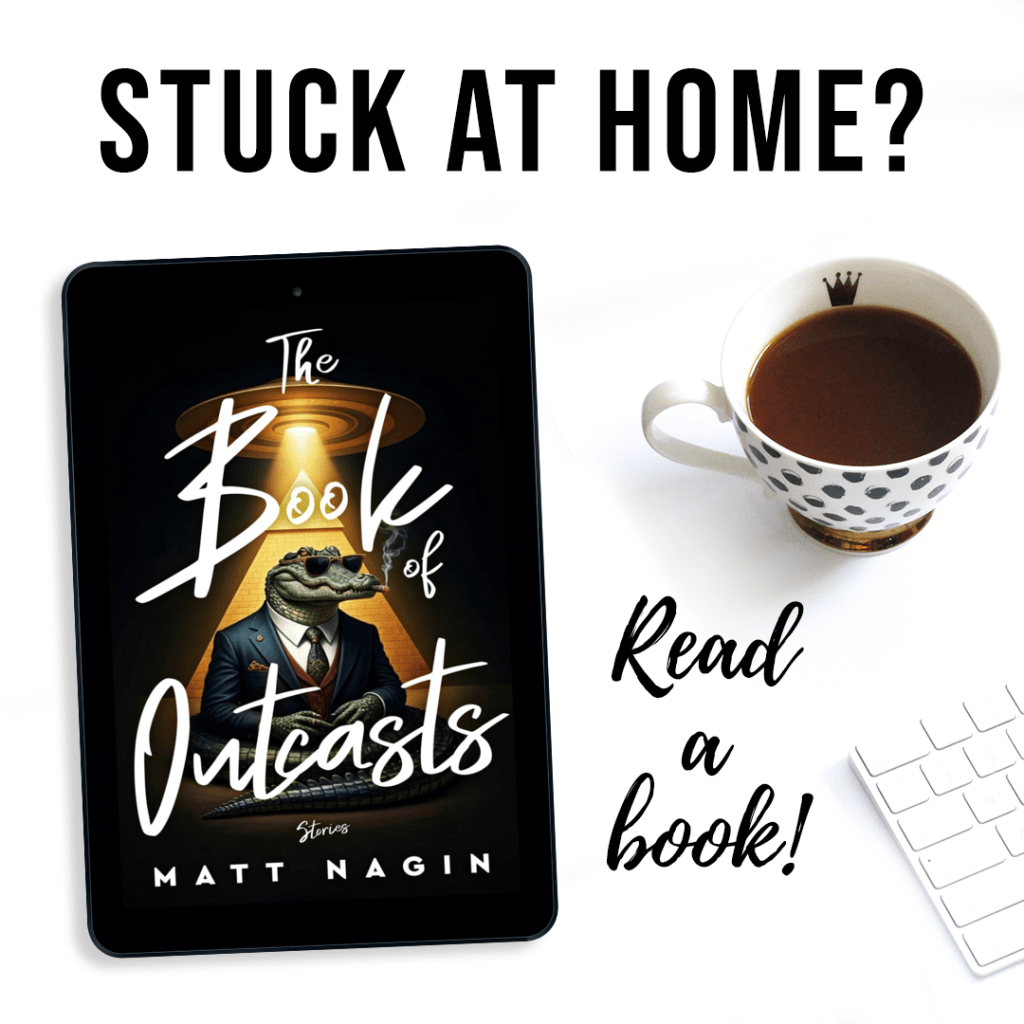
The Book of Outcasts features dynamic characters in surreal, often imaginative worlds. The stories run the gamut; in one, the narrator is stripped of his job, his apartment, and any semblance of civil liberties for not getting a brain implant; in another a compulsive gambler is so desperate to repay his debt he robs a casino; in a third, a writer, tormented by his pernicious doppelganger, goes to all lengths to exact revenge. There is also a film festival operator framed for ghastly murder on The French Riviera; a game show host who profits off a deadly pandemic; and a former nightclub comedian who gets abducted by aliens and taken to a planet where cannibalism is the norm.
Several of these stories were previously published. “The Failure” made “Best of Across The Margin 2021.” “Whose Pandemic Is It Anyway?” was anthologized in The Rabbit Hole Vol 5 in 2022. Still others were published in literary journals such as The Binnacle, Void Magazine, and New Works Review.
The Book of Outcasts will be available on AMAZON on Monday, March 10, 2025! Reserve your copy today.


Matt Nagin is a comedian and author who has published five books, acted in numerous Film and TV projects, and performed standup in seven countries.
As a writer, Matt’s newest book is the short story collection “The Book of Outcasts,” which is available for pre-order now. His humor book “Do Not Feed The Clown” was published by Tenth Street Press and he’s also put out three poetry books (one of which Kirkus Review deemed “powerful verse from a writer of real talent”). Additionally, Matt’s story “The Failure” made Best of Across The Margin and his poem “If We Are Doomed” won The Spirit First Editor’s Choice Award. Other work has been appeared in The Binnacle, NY’s Best Emerging Poets, and Rabbit Hole: Weird Stories Vol. 5. He also taught college writing at such institutions as Fordham, Long Island University, and Fashion Institute of Technology.
As an actor, Matt’s made many TV and film appearances, including in the film “Tango Shalom,” on the Discovery show “Street Justice: The Bronx,” and in the Amazon show “Hunters” in a scene with Al Pacino. As a standup, Matt performed on The Dr. Steve Show, was an opening act for Robert Klein, and performed his one man show at The Edinburgh Comedy Festival. In addition to the above, Matt created the short film “Inside Job,” which won several awards on the festival circuit.
As if all this wasn’t enough, Matt has appeared on numerous game shows, podcasts, radio programs, created a rap video, hosted a film festival, and even was the first person to perform standup in English in Lisbon, Portugal. He’s further long been involved with charitable organization such as The Gotham Comedy Foundation, which brings comedians into hospitals and senior centers, and The Crohn’s and Colitis Foundation, which recently granted him The Mission Award.

Q&A WITH THE AUTHOR
Why do you write fiction?
I find it interesting to explore alternate realities. The other aspect of it is I rarely write with an outline. Hence, I am often entertaining myself when I write since I’m trying to figure out how this story will end. A final element that draws me to it is the editing process, which is really about trying to actualize the ideas in the first draft in the best way possible.
What is your new book about?
It’s a collection of short stories: “The Book of Outcasts.” As the title suggests, it’s really about characters who don’t fit into society for various reasons; they may be criminals, addicts, fringe artists, madmen etc. It’s really about exploring the inner worlds of these characters and the conflicts they face, often in a world that is hostile to their natural impulses. In some stories it’s about survival; in others it’s more about artistic and existential issues; in still others it is about acceptance of life on its own terms.
What got you into writing?
A poetry class I took at a summer program at Penn State got me into writing. In college, I became an English major and took more writing courses. Then I took screenwriting night classes at UCLA and did script coverage while in L.A. After that I did an M.A. at NYU, where there was a bunch of writing, and, for better or worse, I’ve been writing ever since.
What do you think makes a good story?
A plot that moves the action forward in a way that is compelling. The story should keep the reader wanting more. Another important element is capturing experience with immediacy and realism.
What do you want people to take away from your book?
I want them to enjoy the stories and explore these alternate realities. Additionally, in certain cases, my stories comment on aspects of our culture, so it would be great if readers considered our world in light of what the stories are suggesting. For example, Get Your Implant!, is about a man forced to get an A.I. implant to compete in the workforce; he gives up everything to avoid this reality but ultimately cannot hide. It’s a story that comments on the dangers of A.I. and the way technology may not be the Shangri-La some make it out to be. Is technological progress worth losing your soul? What really matters most? Progress? Or being who you really are? The story leaves the reader to reflect on where we as a society are heading.
What else do you want readers to know about you?
I have four other books available, three poetry books and one humor book. I try to change up what I’m doing. This way I’m offering readers something different, something a little unexpected. I think it’s important artistically to keep exploring and taking chances. Readers can reach out to me through my website at mattnagin.com.
LINKS:





































 Nina Soden